The Ultimate Guide to Going Solar in British Columbia (2026)
Check out Solar Prices Near You
Enter your postal code to see what solar panel install cost in your area.
1. Introduction: Why Go Solar in British Columbia?
Investing in solar energy in British Columbia isn’t just an environmental choice — it could be a smart financial decision as well. The average BC household spends between $100 and $150 per month on electricity, and with the right system, solar panels can offset up to 100% of that cost. Depending on your home’s efficiency and system size, the savings can vary — but over the lifetime of the system, you could save tens of thousands of dollars.
At the same time, you’re adding long-term value to your home and significantly shrinking your carbon footprint. That means protecting BC’s natural beauty while also future-proofing your property. Whether you’re a first-time homeowner building equity or looking to boost resale value, going solar may prove to be a smart step forward.
Key Takeaways
- Average home solar system costs: $12,000 and 30,000
- Solar panels cost on average: $2.52 and $3.17 per watt of installed power
- British Columbia solar incentives and rebates: Home Renovation Rebate Program, British Columbia’s Self-Generation (Net Metering) Program, PST Tax Exemption, and other municipal solar programs and rebates.
- Average price per sq. foot for solar in British Columbia: The average home in British Columbia is 2,077 sq. feet. It uses approximately 11,000 kWh of electricity per year. This means that the corresponding solar system for a home of this size would cost roughly $15.07 per sq. foot – and this is before any rebates or incentives are applied.
2. How Solar Power Works
The Basics of Solar Energy in BC
Solar power systems turn sunlight into electricity that you can actually use around your home. When sunlight hits your solar panels, it’s converted into direct current (DC) electricity. That energy is then sent to an inverter, where it’s transformed into alternating current (AC) — the type of electricity your home runs on. From there, it can be used immediately, stored in a solar battery for later use, or fed back into the grid if your area supports net metering. The process is quiet, automatic, and requires very little maintenance once installed.
A solar battery allows you to use solar energy even when the sun isn’t shining — such as at night or during the darker winter months. It stores the excess electricity your panels generate during the day, so you can draw on it whenever you need it. But, batteries add to the upfront cost of your solar system.
However, in British Columbia, BC Hydro’s self-generation service rate offers an alternative. Because you can send surplus energy to the grid and are paid 10¢/kWh for what you export, the grid no longer works as a virtual battery the way it did under the old net metering program. While a physical battery provides true energy independence and backup power during outages, many BC homeowners choose to rely on grid export alone — especially if they want to reduce upfront system costs.

1. Sunlight reaches solar panels and starts generating electricity.

2. The inverter converts Direct Current (DC) into Alternating Current that our appliances can use.
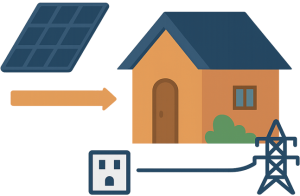
3. Your home appliances use the solar energy first, so you rely less on the grid.
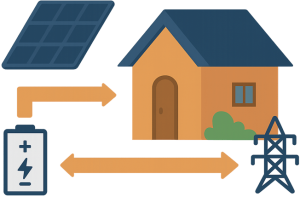
4. Excess electricity is fed into the grid, or in a solar battery if you have one.
3. British Columbia's Solar Energy Potential
| Fuel Type | Canada | British Columbia |
|---|---|---|
| Hydro | 60% | 89% |
| Wind | 6% | 3% |
| Petroleum | 0.3% | 0.1% |
| Biomass | 1.4% | 6% |
| Natural Gas | 1% | 2.4% |
| Solar | 1% | 0.1% |
| Other* | ~30.3% | / |
Energy Profile: Canada and British Columbia Comparison. * Other: Coal and Nuclear combined
British Columbia's Self-Generation (Net Metering) Program
As of July 1, 2026, BC Hydro replaced net metering with its self-generation service rate (Rate Schedule 2289). Rather than banking exported energy as retail-rate credits, you are now paid a flat 10¢/kWh for what you send to the grid, credited each billing cycle. Systems already on the old net metering rate (Rate Schedule 1289) stay on it for 10 years from their service start date. For new BC projects the practical effect is that systems should be sized for self-consumption rather than maximum export, which makes battery storage more valuable than it was under the old rules.
As the prices of energy and fuels keep increasing, solar panels can provide you with the energy independence you need. They also offer a buffer against any energy price increase in the future and help reduce your carbon footprint. Both Canada and British Columbia have been investing heavily in green energy production for decades – and here is a detailed breakdown of where the energy you’re using is coming from.
| Province | Average Annual Sunlight Hours | Solar Potential (kWh/kW per year) |
|---|---|---|
| Alberta | 2,300 - 2,600 | 1,200 - 1,400 |
| Ontario | 1,800 - 2,200 | 1,000 - 1,200 |
| British Columbia | 1,500 - 2,000 | 900 - 1,100 |
| Quebec | 1,700 - 2,100 | 1,000 - 1,150 |
| Saskatchewan | 2,400 - 2,700 | 1,300 - 1,500 |
| Manitoba | 2,100 - 2,500 | 1,150 - 1,300 |
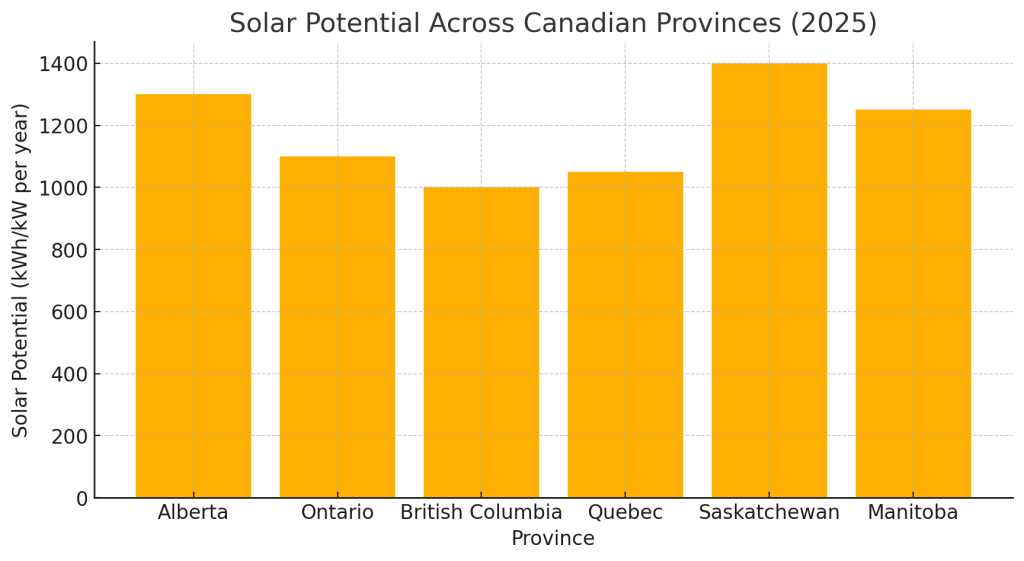
Solar Potential and Viability in British Columbia
A common concern among many homeowners who would go solar is that there are simply not that many sunny days and sunny hours in BC. This is simply not true. BC experiences roughly 300 sunny days a year with around 1004 sunny hours – that’s three hours on an average day, every day of the year. This is plenty to produce the energy a single household needs. Here is the breakdown of a solar system output with a single kW of solar capacity.
| Month | kWh/kW of installed capacity in British Columbia | Energy Production of a 5 kW system in kWh | Energy Production of a 10 kW system in kWh |
|---|---|---|---|
| January | 40 | 200 | 400 |
| February | 58 | 290 | 580 |
| March | 84 | 420 | 840 |
| April | 99 | 495 | 990 |
| May | 104 | 520 | 1040 |
| June | 110 | 550 | 1100 |
| July | 120 | 600 | 1200 |
| August | 118 | 590 | 1180 |
| September | 113 | 565 | 1130 |
| October | 74 | 370 | 740 |
| November | 44 | 220 | 440 |
| December | 37 | 185 | 370 |
| Total - Annual | 1,004 | 5,020 | 10,040 |
The amount of electricity a solar system can generate depends on local sunlight conditions. In British Columbia, even smaller systems can provide meaningful energy savings. For example, a 1 kW solar system in Vancouver (solar panels vancouver bc) can generate about 1,007 kilowatt-hours (kWh) per year. Other cities show similar potential: Surrey and Abbotsford both average around 996 kWh annually, while Richmond reaches 1,027 kWh. When scaled up to 5 kW or 10 kW systems, the potential energy production grows significantly.
| City | 1 kW System | 5 kW System | 10 kW System |
|---|---|---|---|
| Vancouver | 1,007 | 5,035 | 10,070 |
| Surrey | 996 | 4,980 | 9,960 |
| Burnaby | 991 | 4,955 | 9,910 |
| Richmond | 1,027 | 5,135 | 10,270 |
| Abbotsford | 996 | 4,980 | 9,960 |
Does Solar Make Sense in British Columbia?
Investing in solar panels in British Columbia is a great idea. Long summer days, BC Hydro metering system, carbon offsets and a lower or non-existent power bill are all the reasons you may want to call some solar companies in your area and ask for a solar quote for your property.
4. Solar Incentives & Rebates in British Columbia
If you are a resident of British Columbia, there are many federal and provincial solar incentives and rebates that may help you significantly reduce the upfront cost of your solar system and reduce your ROI period.
1. BC Hydro rebates for solar panels and battery storage
-
- Solar photovoltaic (PV) panels:
- $1,000 per kilowatt (kW) of installed generator capacity.
- Rebate amount capped at 50% of total installed product cost (including labour and materials).
- Maximum rebate $5,000.
- Battery energy storage systems
- $500 per kWh of installed storage capacity.
- Rebate amount capped at 50% of total installed product cost (including labour and materials).
- Maximum rebate $5,000 — but only if the battery is enrolled in BC Hydro’s Peak Saver program within 14 days of interconnection approval. Without Peak Saver enrollment, the maximum is $1,500.
- Solar photovoltaic (PV) panels:
2. British Columbia’s Self-Generation (Net Metering) Program
- British Columbia’s self-generation program lets you feed excess solar energy to the grid – and do so with no extra charge. As of July 1, 2026 that energy is no longer banked as credits like it was under the old net metering program. BC Hydro’s self-generation service rate (Rate Schedule 2289) pays a flat 10¢/kWh for everything you export, settled each billing cycle rather than carried into winter. Homes already on the old net metering rate (Rate Schedule 1289) keep it for 10 years from their service start date.
- Interconnection is free, unlike in some other provinces (New Brunswick and Nova Scotia), where an interconnection can exceed $500.
3. PST Tax Exemption
- There is a 7% PST Tax Exemption on properties with solar panels installed – BC is the only province that currently offers this exemption. BC does not offer solar rebates at the provincial level
4. Municipal Solar Incentives in British Columbia
- Kamloops offers the See the Heat Program – you can rent a thermal camera for free, to scan your property for any heat leaks both during summer and during winter
- Vancouver Heritage Energy Retrofit Grant – the Foundation offers rebates applicable to homes that were built before 1940. The rebates go as high as $14,000 and are perfect if you plan on installing multiple green solutions, for example a heat pump and solar panels
- On top of this, many cities offer rebates of anywhere between $350 and $2,000 if you plan to install a heat pump (Vancouver, New Westminster, Kamloops, Whistler, Kelowna, Saanich, Sidney, View Royal, Nanaimo, Powell River, Campbell River, North Cowichan, Duncan, Squamish, Chilliwack, Comox Valley Regional District, Richmond, Vernon)
Pro Tip: Check with your local municipality or installer for current rebates available in your area.
Get Started Today
See the cost and savings you would have if installing solar on your house:
5. The Cost of Going Solar in British Columbia
How Much Does It Cost to Install Solar Panels in British Columbia?
Going solar in British Columbia is more affordable than many people think. The average cost of a fully installed solar system in BC typically ranges between $2.52 and $3.17 per watt. The final price depends on several factors, including the type of panels you choose, the total system size, how complex the installation is (such as roof shape or wiring access), and which local or provincial incentives you can access.
While solar prices have dropped significantly over the past decade, it’s still a substantial upfront investment. However, homeowners may realize long-term savings that make the initial cost well worth it. Let’s consider this in more detail.
Average Solar Installation Costs in British Columbia
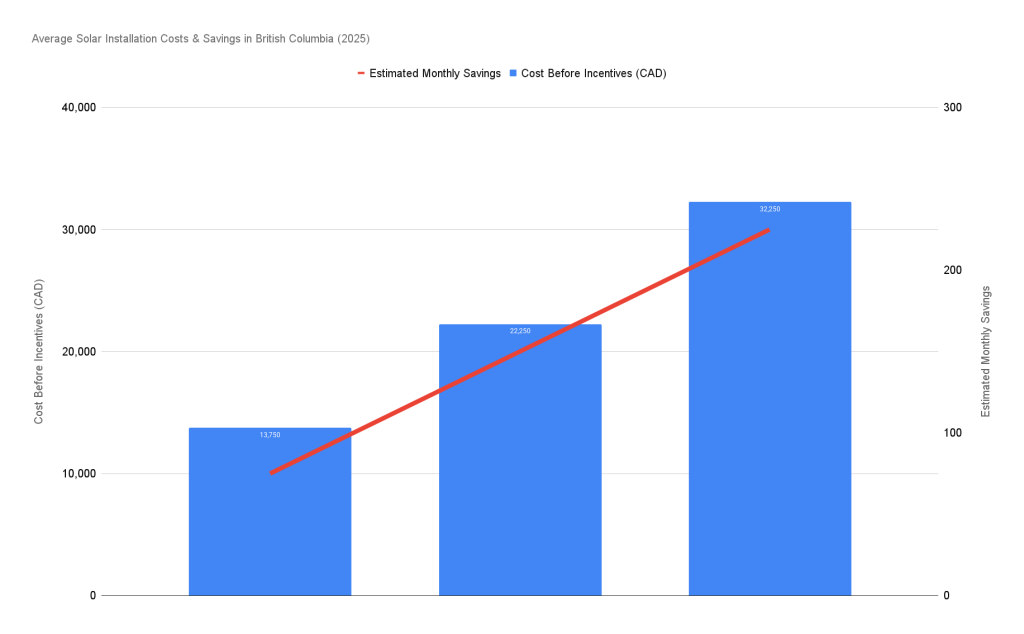
A typical solar panel system in British Columbia costs between $12,500 and $30,000 before any incentives are applied. The total price largely depends on the size of the system and the type of solar panels you may want to choose. The more electricity you may want to generate, the larger the system you’ll need. So while the initial investment may seem high, the long-term savings and value make it a smart upgrade for many BC homeowners.
| System Size | Average Cost (Before Incentives) | Estimated Monthly Savings | Payback Period |
|---|---|---|---|
| 5 kW | $12,500 - $15,000 | $50 - $100 | 8 - 12 years |
| 10 kW | $20,000 - $25,000 | $100 - $200 | 7 - 10 years |
| 15 kW | $30,000 - $35,000 | $150 - $300 | 6 - 9 years |
* Larger systems generate more electricity but also cost more. Most homeowners find solar systems between 5-10 kW to be the right size for them.
What Affects Solar Panel Costs in British Columbia?
There are multiple factors that affect the solar panel cost in BC. Here they are, broken down:
1. System Size & Energy Needs
One of the biggest contributors to your solar array cost is the system size, which depends on your household’s energy needs. Since these two factors are closely connected, it’s a good idea to review your last 12 electricity bills and add up your total energy consumption. This will give you a good but rough estimate of how much power your home typically uses. From there, you can determine the appropriate system size.
2. Solar Panel Type & Quality
There are three main types of solar panels to consider when designing your system: monocrystalline, polycrystalline, and thin-film solar panels. Each type has its own advantages and drawbacks, which we’ll explore in more detail later. For now, the key point is this: monocrystalline panels are the most efficient and require the least amount of roof space, but they also tend to be the most expensive option.
- Monocrystalline Panels (High Efficiency – High Price)
- Polycrystalline Panels (Less Efficient – Less Costly)
- Thin-Film Panels (Flexible – Perfect for Specialized Uses)
3. Battery Storage (Optional but Recommended for Some Homes)
Battery storage is a good option for your solar array system, but you should be aware that it can increase the price of the entire system. As batteries are expensive, many BC homeowners weigh the upfront cost against BC Hydro’s 10¢/kWh export rate before deciding on a battery — exported power is no longer credited at the retail rate, so a battery can be worth more than it used to be. However, in off-grid applications, or if you live in an area that is prone to power outages, you should give them a second thought.
- Battery Costs: $8,000 – $15,000
- Is it Necessary? A solar battery maybe a good investment if you plan on going off grid, want power even during outages or want to maximize your solar savings by using more of your own power instead of exporting it at the 10¢/kWh rate.
4. Installation Costs & Labour
The installation cost and labor cost are also a big contributor to the price of solar panels. When looking for solar installers, you shouldn’t simply opt for the cheapest one, but you should look for a good balance between the price and the quality of labor provided. Online reviews can be quite helpful. Factors to consider:
- Roof Type
- Roof Condition
- Wiring & Electrical Upgrades
- Permits & Inspections
5. Available Incentives & Rebates
Solar incentives and rebates, as well as solar loans can help you bring down the upfront costs of your system quite a lot. When considering the total price, please also bear in mind that your solar panel system will function for at least 25 years and will provide you with significant savings on your energy bill during this time.
What Factors Increase Solar Price in British Columbia?
One of the biggest contributors to the cost of solar panels in British Columbia is the quality and the orientation of your roof. In case that there is any structural damage to your roof or that the supporting structure simply isn’t strong enough to bear the weight of solar panels, you may have to replace it. This can increase the cost of solar installation quite a lot. In some cases, a more modern solution such as solar shingles or BIPV are the way to go.
Another thing to consider is the orientation of your roof. As solar panels are ideally installed on the south-facing slope of the roof, not having one is going to increase the number of solar panels that you have to place on the remaining slopes. Panels should never be installed on the north-facing slope of the roof.
Savings and ROI
When planning an investment, the ROI number is very important. It basically shows you how many years will have to pass for your solar installation system to pay itself off. When it comes to calculating the return on investment, it is important to count in all the incentives and rebates that you will be applying for. For some homeowners, taking out a solar loan with a low interest rate may even prove to be a better option than paying for your solar system outright.
Another factor that you should consider is your current energy bill – it has a fixed and a variable part. You should only consider the variable part of the bill, as it relates to your power consumption. The fixed part is paid for the connection to the grid, and unless you plan to go off grid, you will still be paying the same amount. Some rough calculations may show you that reducing your power consumption by roughly 50% can decrease your energy bill by 36%. In case the total upfront cost is too much, consider financing options.
6. Financing Options for Solar Panels in British Columbia
There are financing options available for all systems where the upfront cost may be too high:
1. Solar Loans & Financing Plans
- Banks and other financial institutions allow solar loans to be taken out, usually with a very low interest rate
- Monthly payments are equal to energy bill savings – you pay the same amount until you pay off the loan
- Consider: Clean Energy Loan in Vancouver (up to $50,000 and 0.75% interest), PACE (paid off through LIC charge)
2. Home Equity Line of Credit (HELOC)
- HELOC loans can help finance your solar system and do so with low interest rates
7. Choosing the Right Solar Panels & Equipment
Choosing the right type of solar panel and the accompanying inverter can be a difficult task, so it is oftentimes best left to professionals. However, here is a breakdown so that you would have an idea of where to aim your research at.
1. Choosing the Right Solar Panels
There are different types of solar panels out there on the market. The most common types are monocrystalline and polycrystalline panels.
Monocrystalline Panels (Best for Efficiency)
- Black in color – a stylish solution for all home styles
- Highly efficient – 18-22% efficiency rate is the highest on the market
- They last upwards of 25 years
- The most expensive option
Polycrystalline Panels (Budget-Friendly Option)
- Budget friendly option for all
- Blueish hue makes them perfect for homes near water bodies
- Efficiency rates of around 16-18% makes them a decent solution for most energy needs
- Take up more roof space and may not be the best solution in all applications
Solar Panels Comparison
Here is a comparison between the most popular solar panel types in British Columbia:
| Panel Type | Efficiency | Cold Weather Performance | Lifespan | Watts per Sqft | Cost |
|---|---|---|---|---|---|
| Monocrystalline | 18-22% | Excellent | 25+ years | More | Higher |
| Polycrystalline | 16-18% | Decent to Good | 25+ years | Fewer | Lower |
Pro Tip: Monocrystalline panels are the way to go: they work more efficiently in colder climates and are more efficient – meaning that you will be getting more solar power even on overcast days.
2. Choosing the Right Solar Inverter
No solar panel can be connected to your electricity installations without an inverter. Solar panels produce direct current which cannot be used by your regular household appliances. For this reason, you will also need an inverter. There are three basic types of inverters on the market, each with its own pros and cons. String inverters, microinverters, and hybrid inverters.
1. String Inverters (Most Common & Affordable)
- One inverter can be used for entire solar systems
- Lower cost and installation costs
- Even partial shading can reduce the efficiency of the entire solar system
2. Microinverters (Best for Roofs with Shade or Different Angles)
- The state-of-the-art technology that allows each solar panel to have its own inverter
- They resolve the issues with partial shading – as panels work independently from one another
- Higher conversion efficiency = more solar power for your home
- More expensive than string inverters
- Each panel has its own inverter, maximizing energy output.
- Best for homes with partial shading or different panel orientations.
- More expensive than string inverters but increases efficiency.
3. Hybrid Inverters (For Battery Storage Integration)
- Allows a battery to be added to your solar system
- Can work without a battery, too, but allows for later expansion
- General recommendation for all homeowners
- Allows seamless battery connection for energy storage.
- Future-proofs your system if you plan to add a battery later.
- Recommended if you’re considering solar batteries like Tesla Powerwall.
Solar Inverters Comparison
Inverter breakdown by type:
| Inverter Type | Best For | Efficiency | Expandability | Battery Storage | Cost |
|---|---|---|---|---|---|
| String Inverter | Roofs with no shade | Good | Limited expandability; additional inverters are suggested | No | Lower |
| Microinverter | Roof with partial shading or multi-slope | High | Yes | No | Higher |
| Hybrid Inverter | Full sun with systems designed for future expansion | High | Yes | Yes | Higher |
Pro Tip: If your roof is partially shaded, microinverters are the way to go. However, in full sun, there is no reason to spend more on microinverters, when a string inverter can do the job.
3. Solar Battery
Adding a solar battery to your solar system will increase the upfront cost. However, if you are looking for more energy independence or are looking to go off-grid, this is the best option for you. Beware of your daily energy use when choosing the right type of battery. Consider that most models can store anywhere between 5 and 10 kWh of excess power.
Final Thoughts
- Monocrystalline solar panels produce most energy per square foot.
- Hybrid inverters are the best type of inverter for most homeowners.
- Solar batteries are a great option for energy independence and further reducing your carbon footprint and energy use, but may not be the best solution for all.
8. Finding a Reliable Solar Installer in British Columbia
Selecting the right solar installer is a crucial part of your solar journey. A professionally installed system can deliver over 25 years of reliable, clean energy. On the other hand, a poorly done installation may result in reduced performance, unexpected costs, and ongoing maintenance issues.
Why Choosing the Right Solar Installer Matters
Proper Permits & Regulations
A good solar installer in BC will be able to get the necessary municipal permits and follow the provincial electrical code to the point.
Maximizing Incentives & Rebates
A good solar installer will be able to secure all available rebates for you and give you information on the best loans in your area.
Long-Term Reliability & Warranties
Solar installers will always give you warranties on their work and the equipment installed. Solar panels typically come with a 25-year warranty, while inverters generally have a 10-year warranty.
Avoiding Scams & Low-Quality Work
Only can install panels safely. This demands a lot of electrical work, which not everyone can carry out safely. A low price comes with many trade-offs and is rarely an economic solution in the long run.
What to Look for in a Solar Installer in British Columbia
There are several factors to consider when looking for a solar installer in British Columbia:
1. Are They Certified & Experienced?
They should be certified by the Canadian Solar Industries Association (CanSIA) or CSA. They should also have experience that spans back at least 3 years.
2. Do They Have Strong Customer Reviews?
Google and SolarGuide.ca are provide a neutral view when it comes to searching for online reviews of your local solar installers. Beware of overly negative or positive reviews and look for those delivered in a moderate tone, with pictures and testimonials.
3. Do They Offer Transparent Pricing & Warranties?
A reputable solar installer will provide a quote with no hidden fees. They should also be able to offer warranties of 25+ years on solar panels and a minimum of 10 years on inverters. They should also be able to draw up rough calculations on potential energy savings.
4. Do They Specialize in BC Solar Programs?
Another sign of a good solar installer is their knowledge of available solar programs in British Columbia – BC Hydro’s self-generation rate, solar rebates and solar loans can help you save a lot, and you should not be going through the bureaucratic jungle by yourself.
Looking for a Reputable Installer in British Columbia?
At SolarGuide, we take the guesswork out of finding a reputable solar installer in British Columbia. Here’s how it works:

We Pre-Vet Every Installer
Only the top companies make it to our lists.

We Rank Installers Based on Quality
Only companies with the best independent reviews and rankings are considered. Pricing transparency, experience, and warranty coverage are taken into consideration as well.
We Help You Compare Quotes
You can get the best system at the best possible price by choosing from multiple competing quotes.

No Risk, No Obligation
When the quotes are delivered to you, you simply choose the one you like. If none suit you, you are free to choose none.
Get a Quote from a Pre-Vetted Solar Installer in British Columbia
Want to find a trusted solar installer in British Columbia? We’ve done the research for you. Get a free, no-obligation quote from a top-ranked, pre-vetted solar installer in your local area today!
9. Top 3 Solar Companies in British Columbia
Based on customer reviews, we’ve compiled a list of top three British Columbia solar companies. They offer a range of comprehensive solar solutions and may be just the right solution for your solar needs. Contact them today to find out about your solar potential and to get a free solar quote.
| Company | Customer Rating | # of Reviews | Contact |
|---|---|---|---|
| Shift Energy Group | 4.9 / 5 | 154 | Get a Quote |
| MAG Solar | 4.9 / 5 | 146 | Get a Quote |
| Ready Solar Inc | 5 / 5 | 115 | Get a Quote |
10. The Solar Installation Process in British Columbia
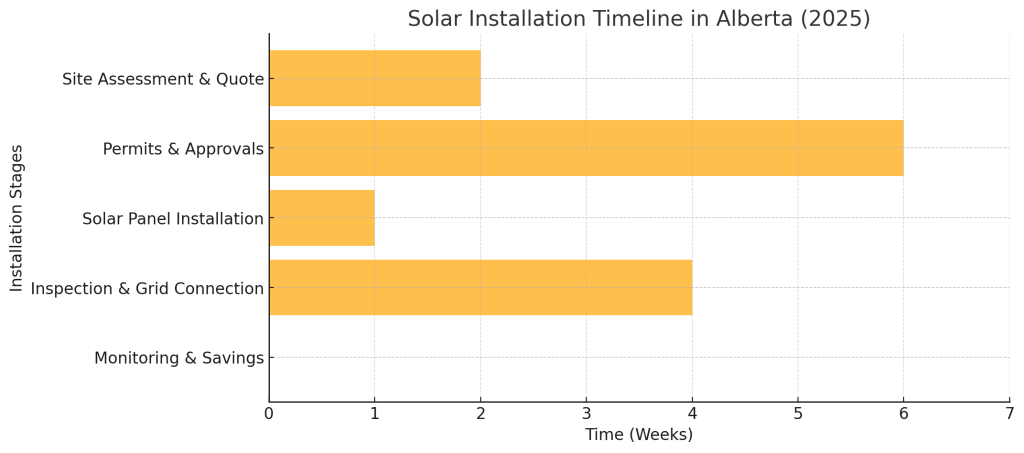
Permitting, installation and connection to the grid are all necessary steps to have a solar system installed. This may seem like too much, but this is a straightforward process that should ensure you get a good service and can reap the benefits of rebates, incentives and lower energy bills for many years to come.
Step 1: Site Assessment & Solar Quote (1-2 Weeks)
- A professional solar installer does on-site inspection of your roof, its orientation and slopes
- A simple energy audit is performed to better understand your energy needs
- You receive a detailed quote with no hidden fees
Pro Tip: Always get multiple quotes from SolarGuide.ca, irrelevant of how good the first offer may sound.
Step 2: Permits & Approvals (2-6 Weeks)
- Municipal building permit,
- Electrical permit,
- Approval from the utility company to establish interconnection to the grid (or first-time connection in new developments)
All of this work is handled by the solar installer, not you.
Pro Tip: More experienced solar installers usually offer shorter processing times.
Step 3: Solar Panel Installation (1-3 Days)
- Mounting the solar panels,
- Making wire connection,
- Installing the solar inverter,
- Installing battery storage if you’ve opted for one,
- System testing.
Pro Tip: 1-3 days is usually enough for the entire installation. More complex work, multi-slope roofs, etc. may take more time
Step 4: Inspection & Grid Connection (1-4 Weeks)
- Final system inspection to make sure safety and electrical codes are met,
- The utility company approves and activates your grid interconnection,
- The system is not turned on yet.
Pro Tip: Patience is the key at this point – it usually takes 1-4 weeks for the inspection to take place.
Step 5: Monitoring & Enjoying Your Solar Savings
- The solar installer should provide you with a monitoring app
- The maintenance involved in owning a solar system is minimal – remove the debris after winter and strong summer storms and you’re good to go,
- Waiting for the system to pay itself off. After this period, the electricity is completely free.
How to Get Started
Ready to install solar? Get a quote from a pre-vetted, highly ranked solar installer in BC today.
11. Selling Excess Solar Power: Understanding Net Billing
Selling Excess Solar Power: Understanding Net Billing in British Columbia
Selling your excess solar power is one of the best financial reasons to go solar in BC today. Under BC Hydro’s self-generation service rate, every kWh you send to the grid is paid out at a flat 10¢/kWh on your bill each billing cycle — there’s no more banking credits from summer to draw down over winter the way the old net metering program worked.
How Does BC's Net Billing Work?
- Your solar system produces electricity.
- You use some of the solar power.
- The extra power flows back to the grid.
- You are paid 10¢/kWh for every kWh sent to the grid, settled on your bill each billing cycle. You then buy power back at the retail rate when your energy needs surpass your generation.
Pro Tip: Under the self-generation rate, sizing your system for self-consumption matters more than maximising what you export.
How Much Do Utility Companies Pay for Excess Solar?
Pro Tip: BC Hydro pays 10¢/kWh for exported power under Rate Schedule 2289. Systems connected before July 1, 2026 remain on the old net metering rate for 10 years from their service start date.
Pro Tip: Shop around for a new energy plan before commiting to one company – some offer higher buyback rates than others – being smart at this point can significantly decrease your ROI.
Who Should Consider Net Billing?
- Homeowners who consistently export more power than they use, since every kWh is paid out at the flat rate.
- People looking to shorten their return on investment period as much as possible.
- Anyone who would like to achieve long-term energy savings.
BC Hydro’s self-generation rate still makes installing solar panels a cost-effective and easy way to reduce your energy bills.
BC's Solar Export Buyback Rate (2026)
All the excess power that you do not use and send to the grid is paid at 10¢/kWh under the self-generation service rate (Rate Schedule 2289) and credited on your bill in each billing cycle. There are no banked kWh credits to carry forward or expire. Systems applying for this self-generation rate with BC Hydro must be under 100 kW in size.
Key Considerations
- Seasonal Rate Switching: These programs allow you to switch between higher and lower energy rates, based on your energy use and production.
- Administrative Fees: Monthly administrative fees are charged to your account every month, so factor them in when weighing your export options with BC Hydro. These fees range, and a few dollars may not seem like much, but the savings do grow over longer periods of time.
- Program Flexibility: The ability to switch rates seasonally with no penalties may help shorten the ROI period and may help you save more in the long run.
12. Common Myths & Misconceptions About Solar
Solar panels have been around for several decades now, and despite tens of millions of units being installed in Canada alone, there are still some myths surrounding their installation. Let’s go and debunk some of those.
Myth #1: “Solar Panels Don’t Work in Cold Climates Like British Columbia”
Fact: Contrary to the popular belief, solar panels perform better in cold climates like British Columbia. This is because the reduced temperature increases their efficiency.
Myth #2: “Solar Power Doesn’t Work on Cloudy Days”
Fact: Solar panels work in any kind of climate, even cold and cloudy climates, such as often found in Canada. Even diffused light when there is a cloud cover can reach the solar panel.
Myth #3: “Solar is Too Expensive”
Fact: Installing a solar system costs a lot, and it costs upfront. However, most solar panels pay themselves back within 7 to 12 years. Considering that they last more than 25 years, this means that you will have at least 12 to 13 years of free electricity in your home.
Myth #4: “Solar Panels Will Damage My Roof”
Fact: Properly installed solar panels will not damage your roof. In fact, as some homeowners like to joke, they offer a layer of protection for your roof against hail and heavy snow buildup.
Myth #5: “Solar Panels Require a Lot of Maintenance”
Fact: Solar panels need to be kept free of dust buildup and debris. In most cases, the light wind that your area may be experiencing and an occasional shower will do 90% of the maintenance for you.
Myth #6: “Solar Won’t Increase My Property Value”
Fact: Solar systems increase your property value and your home resale value. The only way that solar doesn’t increase your home value is if you don’t own it at all. Homebuyers of today are eco-conscious so that homes with solar panels on them sell faster and for higher prices.
13. Conclusion: Is Solar Right for You?
If you think that your energy bill is too high, you’re probably right. Energy prices have been on the rise in the past several years. So, if you would like to take more control over your own electric bill, going solar is the way to go. So, is solar right for you? Most probably, yes.
- Solar is right for you if you plan to stay in your home for at least the payback period of the solar system you plan to install.
- If you have a high energy bill and are paying more than $100 a month, you may want to consider going solar as well.
- If you own a south-facing roof that receives no shade during the day, then you have a good rooftop for a solar array.
- If you’re looking for protection against rising energy costs and want to increase property value as well as the home resale value, then you should go solar.
Pro Tip: Always compare quotes before purchasing any solar pack.
Key Benefits of Going Solar in BC:
- Reducing your energy bill by up to 90%, depending on your current energy needs and the size of the system that you would like to install
- Using your utility grid as an income stream — exported power earns 10¢/kWh under the self-generation rate
- Reducing your carbon footprint by producing your own green energy
- More energy independence and a buffer against rising energy prices
- Increased property value and home resale value.
Solar Panels by City in British Columbia
British Columbia offers excellent year-round solar production — especially in the Okanagan and Southern Interior. Explore our city guides for local costs, BC Hydro export rates, CleanBC rebates, and pre-vetted installers in your area.
Can't find your city? Use our free solar calculator for a personalized estimate anywhere in British Columbia.
Get Started Today
See the cost and savings you would have if installing solar on your house:
Frequently Asked Questions: Solar Panels in British Columbia
Does BC Hydro still offer net metering in 2026?
Not for new customers. BC Hydro closed its net metering service rate (Rate Schedule 1289) to new applicants on July 1, 2026, following the BCUC decision of March 24, 2026. New solar customers are enrolled in the self-generation service rate (Rate Schedule 2289) instead.
How much does BC Hydro pay for excess solar power?
BC Hydro pays a flat 10¢/kWh for electricity you export to the grid, settled in each billing cycle. This replaces the previous model, where exports were banked as retail-rate kWh credits and carried forward to offset winter consumption.
What solar rebates are available in British Columbia?
BC Hydro offers up to $5,000 on eligible grid-connected solar panels and up to a further $5,000 for battery storage on qualifying residential projects. Business customers can access up to $10,000 for solar and up to $10,000 for battery storage. Rebates are first come, first served while funding lasts.
Do I need an HPCN installer to qualify for the BC Hydro rebate?
Yes. Since June 1, 2026, solar and battery installations must be completed by a member of BC Hydro’s Home Performance Contractor Network (HPCN) to be eligible for rebates. HPCN members meet standards for WorkSafeBC compliance, licensing, liability insurance and warranties, and are subject to ongoing quality assurance.
Are solar batteries worth it in BC now?
They are more valuable than they were under net metering. Because exported power earns a flat 10¢/kWh rather than a full retail-rate credit, electricity you consume yourself is worth more than electricity you sell. Storing daytime production for evening use improves returns, and battery storage carries its own rebate of up to $5,000.
What happens to my existing net metering agreement?
Customers already on Rate Schedule 1289 remain on it for 10 years from their initial net metering service start date, then transfer automatically to the self-generation rate. If you received a BC Hydro solar rebate you moved to the new rate on July 1, 2026, though customers who received a rebate before the March 24, 2026 BCUC decision have a one-time option to repay it and stay on the old rate.