Solar Panels Nova Scotia (2026): Costs, Rebates & Installation Guide
A Complete Guide to Solar Energy in Nova Scotia
See Solar Prices Near You
Enter your postal code to see what solar panel installations cost in your local area.
1. Introduction: Why Go Solar in Nova Scotia?
Nova Scotia homeowners pay some of the highest electricity rates in Atlantic Canada. NS Power’s residential rate sits at approximately 19.1¢/kWh — which means the average household spending $150–$200/month on electricity stands to save significantly with a well-sized solar system. With NS Power’s net metering program crediting your excess solar at the full retail rate, a 10 kW system can offset 100% of a typical household’s annual electricity use — and because both the SolarHomes rebate and federal programs are now closed, net metering is how the economics work in 2026. The stronger your electricity bills, the faster solar pays back.
Key Takeaways
- Average installed cost (10 kW): $28,000–$35,000 before incentives
- Cost per watt: ~$3.15/W installed
- NS Power net metering: Credits at 19.1¢/kWh — Canada’s best net metering rate. 12-month credit rollover.
- Halifax PACE financing: 4.75% fixed over 10 years via Solar City program (HRM residents only)
- SolarHomes Program: ❌ Closed April 17, 2025 — no longer accepting applications
- Canada Greener Homes Grant: ❌ Closed February 2024
- Typical monthly savings: $100–$200/month for a 10 kW system
- Payback period: 7–12 years (net metering only, no direct rebate)
- Eligible system size: Up to 100 kW for net metering in NS
2. How Solar Panels Work in Nova Scotia
During day, sunlight hits your solar panels and generates electricity. The electricity that’s generated in this process is direct current or DC. Before you can use it in your household, it has to be converted to AC or alternating current. This conversion happens in solar inverters, an integral part of every solar panel system. On top of this, your system can also have a solar battery, but as they are very costly, most people decide not to install them.
So what do you do with excess electricity that you generate but cannot use up? This electricity can be fed back into the grid. The program that allows this is called net metering and you will need an interconnection to be able to do so. However, if you live off grid, a solar battery is really the only way to store energy and be able to use it even after the sun is out.
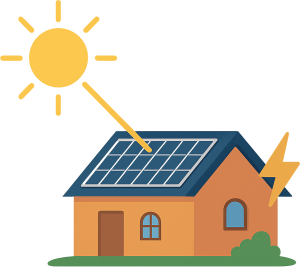
1. Sunlight shines on solar panels, generating DC electric current.

2. The inverter converts DC power into AC power for home use.
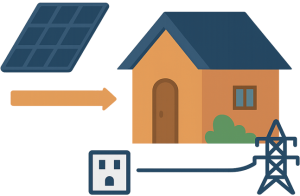
3. You use as much energy as you need, pulling less electricity from the grid.
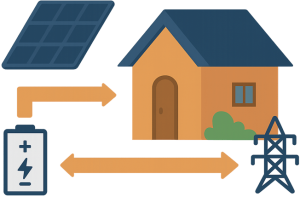
4. Excess electricity is fed into the grid, or stored in a solar battery.
3. Nova Scotia Solar Potential: How Much Power Will Your System Generate?
Nova Scotia receives approximately 1,700–1,900 sunshine hours annually — comparable to countries like Germany and the UK that have thriving solar industries. The province’s climate is actually well-suited to solar: cold temperatures improve panel efficiency (solar panels generate more power in cold, clear weather than in summer heat), and the coastal location means fewer extended cloudy periods than inland provinces. A well-sized 10 kW system produces approximately 10,900 kWh per year — enough to offset 100% of a typical Nova Scotia household’s electricity use. Panels are warranted for 25 years, so even at a 10-year payback you’re looking at 15 years of near-free electricity.
| Province | Average Annual Sunlight Hours | Solar Potential (kWh/kW per year) |
|---|---|---|
| British Columbia | 1,500 - 2,000 | 900 - 1,100 |
| Alberta | 2,300 - 2,600 | 1,200 - 1,400 |
| Saskatchewan | 2,400 - 2,700 | 1,300 - 1,500 |
| Manitoba | 2,100 - 2,500 | 1,150 - 1,300 |
| Ontario | 1,800 - 2,200 | 1,000 - 1,200 |
| Quebec | 1,700 - 2,100 | 1,000 - 1,150 |
| New Brunswick | 1,890 - 2,000 | 1,000 - 1,150 |
| Nova Scotia | 1,700 - 1,900 | 1,073 - 1,200 |
| Prince Edward Island | 1,800 - 2,000 | 1,100 - 1,125 |

Solar Irradiance & Annual Output by NS City
January is the least sunny month with approximately 66 kWh produced per kW installed, while June, July, and August each produce around 111–112 kWh/kW — nearly double winter output. This seasonal swing is exactly why NS Power’s 12-month credit rollover makes net metering so powerful in Nova Scotia: surplus electricity you generate all summer accumulates as credits you draw down through winter, making your annual production — not any single month — the metric that drives your savings.
Nova Scotia also has a unique advantage for solar owners: Renewable Energy Certificates (RECs). NS Power allows you to register and document RECs on your behalf annually. Once obtained, you can either retire them (claiming the environmental benefit of the solar power you generated) or sell them on the voluntary carbon market — an additional income stream that most NS homeowners don’t know about. Consult your installer for details on how to register through NS Power.
| Month | kWh/kW of installed capacity in Nova Scotia | Energy Production of a 5 kW system in kWh | Energy Production of a 10 kW system in kWh |
|---|---|---|---|
| January | 66 | 330 | 660 |
| February | 89 | 445 | 890 |
| March | 105 | 525 | 1,050 |
| April | 98 | 490 | 980 |
| May | 106 | 530 | 1,060 |
| June | 112 | 560 | 1,120 |
| July | 111 | 555 | 1,110 |
| August | 111 | 555 | 1,110 |
| September | 102 | 510 | 1,020 |
| October | 82 | 410 | 820 |
| November | 56 | 280 | 560 |
| December | 52 | 260 | 520 |
| Total - Annual | 1,090 | 5,450 | 10,900 |
Energy Output per 1kW, 5kW and 10kW of installed solar capacity in Nova Scotia. Source: Energy Hub
Not all places in Nova Scotia receive exactly the same amount of solar energy. So, for example, if you live in Halifax, you can expect that your solar array will produce 1,073 kWh/kW. At the same time, Dartmouth produces 1,076, while Amherst is the absolute winner with 1,125 kWh produced.
| City | 1 kW System | 5 kW System | 10 kW System |
|---|---|---|---|
| Halifax | 1,073 | 5,365 | 10,730 |
| Dartmouth | 1,076 | 5,380 | 10,760 |
| Truro | 1,095 | 5,475 | 10,950 |
| Amherst | 1,125 | 5,625 | 11,250 |
| New Glasgow | 1,081 | 5,405 | 10,810 |
Estimated Energy Production in different Nova Scotia cities, with a 1kW, 5kW and 10kW solar system
Is Solar Good in Nova Scotia's Climate?
Despite not being the sunniest province, Nova Scotia is an excellent market for solar in 2026 for three reasons:
- Canada’s best net metering rate: At ~19.1¢/kWh, NS Power credits your exported solar at the full retail rate — far more valuable than provinces that pay wholesale rates of 4–10¢/kWh. This single fact makes solar math work in NS without any upfront rebate.
- Cold climate efficiency bonus: Solar panels are semiconductor devices that actually perform better in cold weather. Nova Scotia’s mild summers and cold winters mean your panels produce closer to their rated output year-round compared to hotter provinces where summer heat reduces efficiency.
- Long summer days: While winters are short on sun, NS summer days are long — June and July deliver 111–112 kWh per kW installed. Net metering captures all that surplus and banks it for winter, making the system work as one continuous annual cycle rather than month-to-month.
4. Solar Rebates & Incentives in Nova Scotia (2026)
Nova Scotia’s solar incentive landscape changed significantly in 2025. Both the federal Greener Homes programs and the provincial SolarHomes rebate are now closed. However, NS Power’s net metering program remains one of the best in Canada, crediting excess solar at the full retail rate.
1. Canada Greener Homes Grant — ❌ CLOSED Feb 2024
The Canada Greener Homes Grant closed permanently to new applications in February 2024. The Canada Greener Homes Loan closed October 1, 2025. Neither program is accepting new applications. Existing approved applications continue to be processed. Do not trust any installer or website that claims these programs are still available.
2. SolarHomes Program — ❌ CLOSED Apr 2025
The Nova Scotia SolarHomes Program closed to new residential applications on April 17, 2025 due to high demand. It previously offered $0.30/watt up to $3,000. Only registered non-profits and charities can now apply.
With SolarHomes closed and both federal programs closed, net metering is now the primary financial incentive for Nova Scotia homeowners. NS Power’s net metering rate of ~19.1¢/kWh is the highest in Canada and more than compensates for the lack of upfront rebates over the life of the system. Halifax residents also have access to the Solar City PACE financing program.
3. Net Metering ✅ Active — Canada's Best Rate (19.1¢/kWh)
NS Power’s net metering program is the primary — and best — financial incentive for going solar in Nova Scotia in 2026. With both the SolarHomes rebate (closed April 2025) and federal Greener Homes programs (closed 2024–2025) now unavailable, net metering is how solar economics work in this province.
Under net metering, your solar system generates electricity during daylight hours. Whatever you don’t consume immediately flows back into the NS Power grid, and your meter runs backward — earning credits at approximately 19.1¢/kWh. Those credits accumulate across the billing period and are applied against your electricity bill. NS Power allows credits to roll over for up to 12 months, meaning the large surpluses you generate in summer offset your higher-consumption winter months automatically.
For context, Nova Scotia’s 19.1¢/kWh net metering rate is:
- Double what BC Hydro pays new customers (~10¢/kWh from July 2026)
- Quadruple Manitoba’s net-billing rate (~4.4¢/kWh)
- Higher than Alberta (~9¢/kWh), Saskatchewan (~7.5¢/kWh), and New Brunswick (~14.8¢/kWh)
This rate difference is the key reason solar pencils out in Nova Scotia without any upfront rebate — you get full retail value for every kWh you export, year-round.
Pro Tip: Always check your current buyback rates as they tend to change. Check in with your local utility company or municipality office.
Get Started Today
See the cost and savings you would have if installing solar on your house:
5. How Much Do Solar Panels Cost in Nova Scotia?
Nova Scotia Solar Costs by System Size (2026)
One issue that you may notice with solar panels is the high upfront cost. However, generous rebates and Nova Scotia net metering can help you significantly reduce these costs so that your solar panels can pay for themselves within 7 to 12 years, depending on the system size. After this pay-off period, all the electricity that you generate will be completely free. Most solar panels last some 25 to 30 years, so that you will be able to enjoy free electricity for 15+ years after the installation.
What's the Average Solar Price in Nova Scotia?
The average Nova Scotia household uses roughly 10,000 kWh of electricity per year. A 10 kW solar system produces approximately 10,900 kWh annually in NS — enough to offset 100% of typical usage. With both the SolarHomes program and federal Greener Homes programs now closed, net metering is the primary financial mechanism. At NS Power’s rate of ~19.1¢/kWh, a well-sized system can save $100–$200/month and pay itself off in 7–12 years — then generate free electricity for 15+ years.
| System Size | Cost Before Incentives | After Halifax PACE (10yr @ 4.75%) | Est. Monthly Savings (Net Metering) | Payback Period |
|---|---|---|---|---|
| 5 kW | $14,000–$16,500 | ~$130–$155/mo financed | $50–$100 | 10–14 years |
| 10 kW | $28,000–$35,000 | ~$260–$325/mo financed | $100–$200 | 7–12 years |
| 15 kW | $42,000–$51,000 | ~$390–$475/mo financed | $150–$300 | 6–10 years |
* No provincial rebate currently available. Federal programs closed. Savings based on NS Power net metering at ~19.1¢/kWh retail rate. Halifax PACE financing through Solar City at 4.75% fixed over 10 years for HRM residents.
Key Factors That Influence Solar Costs in Nova Scotia
There are a number of factors that can influence the price of your solar array system. Among this is the equipment (solar panels, solar inverter, wiring), labor, permitting and admin fees, and some other connected costs. If you live in a particularly old house with an old roof that may not be able to support the weight of the panels, we recommend replacing the roof first. Let’s consider some other factors now in more detail:
1. System Size and Household Energy Use
Needless to say, the higher your energy needs are, the larger the solar system you will need. Although for most households a 10 kWh system is going to be just enough, some larger homes may have higher energy use and need a larger system. This will increase the price.
2. Type and Quality of Solar Panels
Not all solar panels are made the same. Monocrystalline, polycrystalline, and thin-film solar panels all come with different efficiencies and different price tags. For this reason, carefully consider your energy needs and contact experts to help you find the best solar panel type for your solar installation.
3. Battery Storage (Optional, but Good for Some Homes)
Another factor that can significantly increase the price of your solar array is the solar battery. Solar battery storage is optional, but it is recommended if you would like to go off-grid, gain even greater energy independence, or rely solely on your electricity using the grid as backup power.
4. Installation and Labour Expenses
Installation costs should be considered as well as they make up roughly 16-27% of the total costs. We recommend that you do not try to save any money on labor costs, as you may end up with lower quality installation and possible malfunction.
5. Available Incentives and Rebates
As not all rebates and incentives are available to everybody in all regions and at any given moment, we recommend that you ask around before committing to go solar. This way you can be certain that you will receive all the available incentives and rebates and significantly decrease the cost of your solar installation.
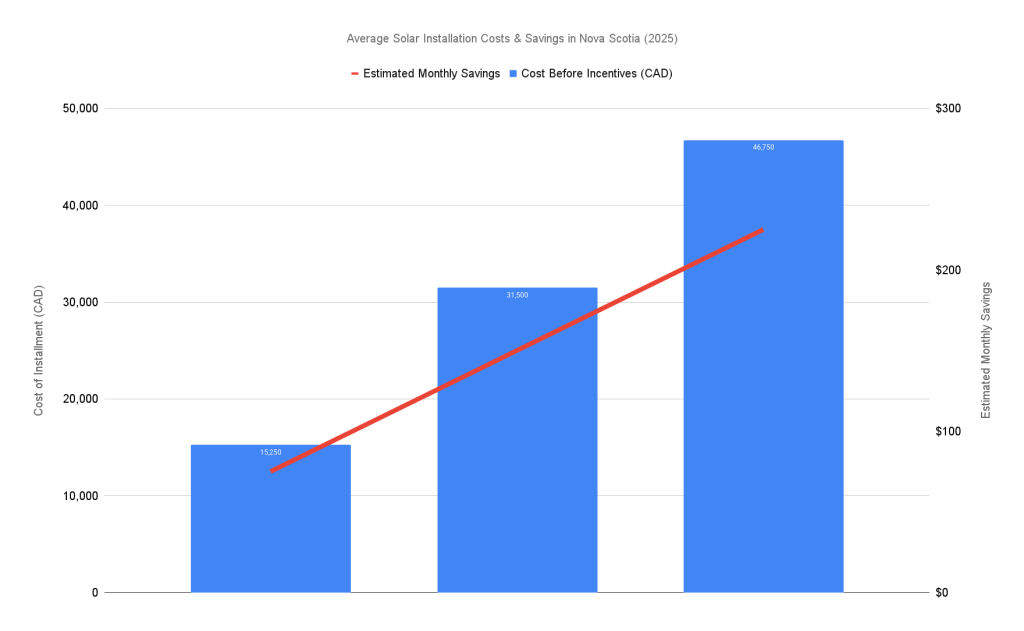
Solar Panel ROI in Nova Scotia: Payback Period & Monthly Savings
In Nova Scotia, solar pays for itself through net metering savings alone — no upfront rebate required. Here’s how the math works for a typical 10 kW system:
- Annual production: ~10,900 kWh (at NS average of 1,090 kWh/kW)
- Value at 19.1¢/kWh net metering rate: ~$2,017/year in electricity savings or credits
- System cost: $28,000–$35,000 installed
- Simple payback: 14–17 years net metering only (no upfront rebate)
- With Halifax PACE financing (no upfront cost): Cash flow positive from day one if monthly savings exceed financing payments
After payback, a 25-year panel warranty means 8–11 years of near-free electricity. Over the full system life, a 10 kW system in Nova Scotia can generate $40,000–$50,000 in cumulative electricity savings — well above the installation cost. The calculation improves further if NS Power rates increase over time, which they historically have.
6. Financing Solar Panels in Nova Scotia
There are financing options to help with the upfront costs:
1. Halifax Solar City PACE Financing (4.75%, 10 Years)
Halifax Solar City PACE Program (HRM residents only):
- Low-interest financing at 4.75% fixed over 10 years
- Tied to your property, not your personal credit — transfers to new owner on sale
- No upfront cost — repaid via property tax bill
- Available within Halifax Regional Municipality (HRM) boundaries
- One of the best financing options for solar in Atlantic Canada
Bridgewater PACE Program: Up to $40,000 for 10–15 years. Check current availability with the Town of Bridgewater.
Other municipalities: Several NS municipalities offer PACE-style financing at $15,000–$40,000 over 10–15 years. Contact your local municipality to confirm current availability.
2. Lease and Power Purchase Agreements (PPA)
Under a PPA agreement, you do not own the solar system, nor the credits from net-metering. However, you will be able to enjoy lower electricity rates in exchange for your roof space.
3. Home Equity Line of Credit (HELOC)
A HELOC lets you borrow against the equity in your home, and you can use this money to finance your solar system. Current interest rates in Nova Scotia are around 7-8%.
7. How Many Solar Panels Do You Need in Nova Scotia?
1. Choosing the Right Solar Panels
There are two basic types of panels: monocrystalline and polycrystalline.
Monocrystalline Panels (Best for Efficiency and Cold Climates)
Monocrystalline solar panels come at highest efficiencies of around 18-22%. This means that you will need the least number of them on your roof to produce the power outputs that you need. However, they come at the highest price tag, so some homeowners prefer to install polycrystalline solar panels.
Polycrystalline Panels (Budget-Friendly)
Polycrystalline solar panels come at lower efficiencies, between 16 – 18%, but also at a lower price tag. Most homeowners prefer these solar panels, as just a few more panels give you the same power output as monocrystalline panels.
Solar Panels Comparison
Both types of solar panels will do their job equally well. Monocrystalline panels are the best solution if you have limited roof space or high energy needs. Polycrystalline solar panels are lower in efficiency, so you will need more of them, but they are a more affordable option.
| Panel Type | Efficiency | Cold Weather Performance | Lifespan | Watts per Sqft | Cost |
|---|---|---|---|---|---|
| Monocrystalline | 18-22% | Excellent | 25+ years | More | Higher |
| Polycrystalline | 16-18% | Decent to Good | 25+ years | Fewer | Lower |
Pro Tip: Monocrystalline solar panels with microinverters are especially good for Nova Scotia’s climate as you want the highest possible efficiency and lowest possible losses in your system, especially during winter months. .
2. Selecting the Right Solar Inverter
Solar panels produce electricity that comes in the DC form. DC stands for direct current. However, all your household appliances can only use AC or alternative current. To convert one into the other, you need a solar inverter. There are three basic types of solar inverters: string inverters, microinverters, and hybrid inverters.
1. String Inverters (Most Common & Affordable)
- Lower costs and lower installation costs.
- One inverter can handle the power output of your entire solar system.
- Partial shading reduces the efficiency of the entire system.
- Cheap and reliable lasting up to 10 years.
2. Microinverters (Best for Roofs with Shade or Different Angles)
- More expensive, but the top of the technology.
- Each solar panel comes with its own microinverter.
- Higher efficiency.
- More expensive than string inverters.
3. Hybrid Inverters (For Battery Storage Integration)
- They allow for system expansion later on.
- They can handle a solar battery.
- They can work without a solar battery.
- General recommendation for all homeowners.
- The best solution after microinverters.
Solar Inverters Comparison
Inverter breakdown by type:
| Inverter Type | Best For | Efficiency | Expandability | Battery Storage | Cost |
|---|---|---|---|---|---|
| String Inverter | Roofs with no shade | Good | Limited expandability; additional inverters are suggested | No | Lower |
| Microinverter | Roof with partial shading or multi-slope | High | Yes | No | Higher |
| Hybrid Inverter | Full sun with systems designed for future expansion | High | Yes | Yes | Higher |
Pro Tip: If you have a full-sun roof, string inverters are the best option. If you have a partially shaded roof, microinverters are the best option.

3. Solar Storage – Is It Worth It?
Solar batteries can store anywhere between 5 – 10 kWh of energy. For most households this is enough for day-to-day operations, but a battery of this size cannot store solar power for multiple days at a time.
This makes them difficult to use during the winter months as they simply won’t have enough energy stored to power your home. We recommend solar batteries for those that are looking to go off-grid or those that want to rely on their own power generation for as long as possible.

Which Solar Setup Is Right for Your Nova Scotia Home?
Monocrystalline solar panels are the most efficient solution there is.
Microinverters are the best type of solar inverters.
Hybrid inverters are the best solution if you want a solar battery.
8. Finding a Trusted Solar Installer in Nova Scotia
There are many solar installers working in Nova Scotia. Each of these companies offers different packages coming at different prices. For this reason, let’s consider some important factors in choosing the proper solar installer to do your job.
Why Choosing the Right Solar Installer Matters
Permits, Approvals, and Local Regulations
Finding a professional solar installer is important because they will be able to handle all the necessary building permits and the electrical code of your area. Not doing so can result in penalties or a fire hazard.
Maximizing Incentives and Rebates with the Right Installer
A professional solar installer will be able to present to you all the possible incentives and rebates that you can get in Nova Scotia. They will also be able to apply for those in your name.
Warranties and Long-Term Reliability
A solar installation that is done well will serve you for many decades to come. The thing is that solar installation is not an easy or a cheap project, so you should always look for the best possible installer. Installers that are not professional can damage your system and cause higher costs in the long run.
How to Avoid Scams and Low-Quality Work
Unreasonably cheap solar quotes often come at a very low quality of installation. As solar equipment is very sensitive and expensive, we always recommend going for a reasonable price.
What to Look for in a Nova Scotia Solar Installer
If you are looking for a solar installer in Nova Scotia, here are some factors to consider when choosing the one to do your job.
1. Certification and Experience
They should have at least three years of prior experience, and they should be certified. The certification body in Canada is CSA, or the Canadian Solar Industries Association, CanSIA.
2. Customer Reviews and Testimonials
You should always check out SolarGuide.ca and Google local services in search for customer reviews. With reviews, you should stay away from overly positive or negative ones and rather pay attention to those delivered in a moderate tone with testimonials.
3. Transparent Pricing and Warranty Options
A good solar installer will be able to offer transparent pricing and warranties. When it comes to the pricing, there should be no hidden fees and the quote you receive should be itemized. Make sure to double check for warranties as solar panels come with the 25-year warranties while solar inverters come with a 10-year warranty. Anything below this shouldn’t be accepted.
4. Knowledge of Nova Scotia’s Solar Programs
Your solar installer should also specialize in Nova Scotia’s solar programs. They should be aware of all the incentives and rebates and help you access those.
Find a Pre-Vetted Nova Scotia Solar Installer
Our team works hard to find the best possible installers. Always check out our recommendations, but also do your own research to bring the most educated decision.

We Carefully Vet Every Installer
Only trusted, top-rated companies make it onto our list.

Quality Over Quantity
Installers are chosen based on their results — backed by independent reviews, verified rankings, fair pricing, industry expertise, and reliable warranties.
Simplified Quote Comparison
Get multiple competitive offers makes it easy to find the right system at the best value.

Zero Pressure, Zero Commitment
You’re in control — review your quotes and decide. If none are the right fit, there’s no obligation to move forward.
Get a Quote from a Pre-Vetted Solar Installer in Nova Scotia
Want to find a trusted solar installer in Nova Scotia? We’ve done the research for you. Get a free, no-obligation quote from a top-ranked, pre-vetted solar installer in your local area today!
9. Top 3 Solar Companies in Nova Scotia
Based on customer reviews, we’ve compiled a list of top three Nova Scotia solar companies. They offer a range of comprehensive solar solutions and may be just the right solution for your solar needs.
| Company | Customer Rating | # of Reviews | Contact |
|---|---|---|---|
| 1st Electric | 5 / 5 | 224 | Get a Quote |
| Greenfoot | 4.9 / 5 | 1,100 | Get a Quote |
| Polaron | 4.7 / 5 | 361 | Get a Quote |
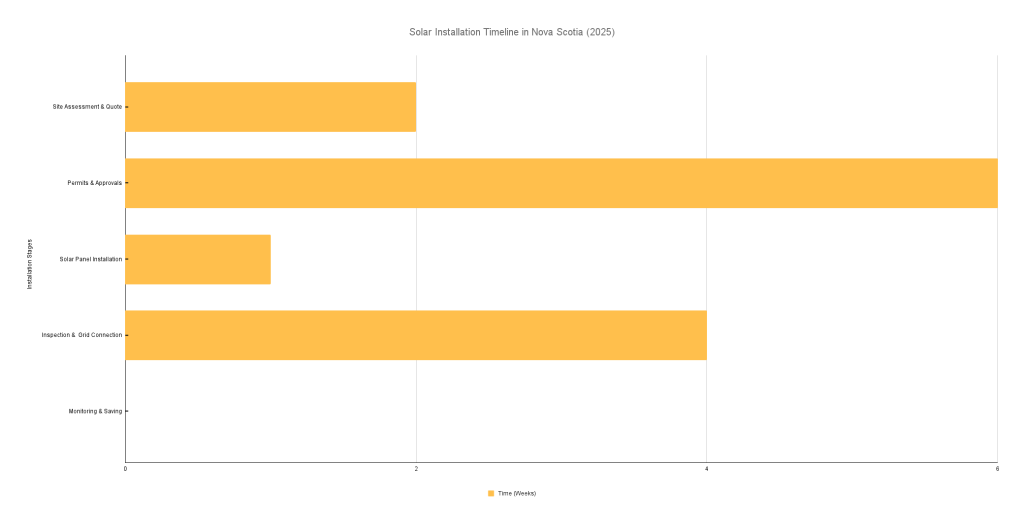
10. The Solar Installation Process in Nova Scotia
Once you have found the best solar installer in your area, it is important to understand the necessary steps in the solar installation process. Here they are, broken down.
Step 1: Site Assessment & Solar Quote (1-2 Weeks)
- A rooftop inspection is done by a specialist.
- An energy audit of your home is performed to better understand your energy needs.
- You receive a detailed itemized quote with no hidden fees.
Pro Tip: Always seek multiple quotes and carefully compare their offers.
Step 2: Permits & Approvals (2-6 Weeks)
- Municipal permits are obtained.
- Electrical permits are obtained as well.
- There is no application for utility company approval in Nova Scotia.
Pro Tip: Some experienced installers can fast-expedite the process of getting the permits, as they are more experienced and can halde paperwork faster.
Step 3: Solar Panel Installation (1-3 Days)
Mounting the solar panels,
doing the wiring of your solar power system,
installing the solar inverter,
installing the solar battery if you chose to install one,
system pre-testing.
Pro Tip: In most cases, it takes up to three days to finish a solar installation.
Step 4: Inspection & Grid Connection (1-4 Weeks)
The system inspection is carried out.
The utility company approves and activates your net metering.
The system is turned on.
Pro Tip: Inspection and interconnection usually take 1 – 4 weeks.
Step 5: Monitoring & Enjoying Your Solar Savings
- Most solar systems come with a solar generation monitoring app that you can install on your phone and track generation in real time.
- Regular maintenance is carried out.
- Regular inspections are carried out as well.
- There is almost no maintenance besides an occasional cleaning of the panels.
How to Get Started
Ready to install solar? Get a quote from a pre-vetted, highly ranked solar installer in Nova Scotia today.
11. NS Power Net Metering — Canada's Best Solar Rate (19.1¢/kWh)
Net metering is one of the best solar incentives in Nova Scotia. With this program, you can feed your excess electricity into the grid during the summer months, when it is very likely that your solar generation will exceed your consumption. For doing so, you receive energy credits that you can use at night, or during winters when the generation is lower.
NS Power Net Metering: Selling Solar Back to the Grid
NS Power’s net metering program is open to all residential customers with solar systems up to 100 kW. No special approvals are required for systems under 27 kW — just the standard interconnection process. Key program features:
- 12-month credit rollover: Credits don’t expire monthly — they accumulate for a full year before any surplus is cleared, which perfectly suits Nova Scotia’s seasonal production profile.
- Multi-site credit sharing: One of NS’s most useful features — if you own multiple properties in the same NS Power distribution area, surplus credits from one property can be applied to reduce bills at another. Ideal for landlords with adjacent rental properties.
- Battery storage compatible: You can add battery storage to your system without losing net metering eligibility or changing your billing structure.
- No administrative fees: Residential systems under 27 kW are exempt from the per-kW monthly fees that previously applied. You pay no ongoing program costs beyond the standard interconnection meter.
- Renewable Energy Certificates (RECs): NS Power documents RECs on your behalf annually. You can sell these on the voluntary carbon market or retire them to claim the environmental benefit — an additional revenue stream unique to Nova Scotia.
How Does Net Metering Work in Nova Scotia?
- Your solar panel system generates electricity for as long as there is sunlight.
- You use some of this electricity.
- The excess is fed into the battery if you have one. If not, the excess is sent to the grid.
- You receive energy credits. You use these credits when the sun isn’t shining.
Pro Tip: Energy credits save energy for later use. The grid serves as a virtual battery for you.
Nova Scotia's Solar Net Metering Buyback Rates (2026)
When you export solar power to the NS Power grid, you’re credited at a 1:1 retail rate — approximately 19.1¢/kWh as of 2026, inclusive of delivery charges. This means every kWh you export is worth the same as every kWh you would otherwise buy from the grid.
This full retail-rate crediting is what makes Nova Scotia’s net metering one of the most valuable in Canada. Some provinces credit solar exports at the wholesale generation rate only (4–10¢/kWh), which significantly reduces the financial value of solar. In Nova Scotia, there is no such discount — exported power is worth exactly as much as imported power.
Rates are set by the Nova Scotia Utility and Review Board (UARB) and reviewed periodically. To confirm the current approved rate before signing an installation contract, check NS Power’s website or ask your installer.
🏆 Best net metering rate in Canada: NS Power credits excess solar at approximately 19.1¢/kWh — the full retail rate including delivery charges. This is significantly higher than most other provinces and means your exported solar power is worth the same as power you would otherwise buy from the grid. Credits accumulate for 12 months before expiry.
Pro Tip: Always check multiple energy providers in your area – some may offer higher buyback rates than others.
Key Considerations
- Seasonal Rate Switching: Nova Scotia doesn’t allow seasonal rate switching, as they offer a flat rate that is the same during the day and night and between the seasons. With this, it is easy to conclude that you cannot switch rates to save.
- Administrative Fees: When it comes to administrative fees that you have to pay to actually use net metering, most of those have been prohibited in Nova Scotia. Before, people used to pay $8 per kW of installed power every month, but this system was withdrawn. So if you own a residential system that is under 27 kW of power, you are not required to go through any approval process or to pay any fees. However, you will still need to undergo safety inspection and the interconnection meter setup.
- Program Flexibility: The program is very flexible as it allows all residential users with solar systems up to 27 kW of power to be connected to the grid without asking for any special permits. However, it is important to note that whatever your system size is, your annual energy production cannot go over your energy needs.
You can even connect multiple generators to one net metering agreement or you can use the power produced in a single location to give energy credits on multiple sites for as long as the sites are within the same distribution area. The program also allows for battery storage to be installed with no additional payments and without influencing your cap.
Another important thing to notice is that Nova Scotia Power allows you to register and document Renewable Energy Certificates on your behalf annually. Then, once you have obtained these RECs, you can either put them out of circulation, which would mean that you gather all the benefits of carbon emissions that haven’t been produced, or that you can sell them. Selling RECs is a viable way of increasing your income and further reducing your ROI.
12. Common Myths About Solar in Nova Scotia Debunked
Although solar power has been around for a while, there are still some myths surrounding it that we should debunk. Let’s head straight on.
Myth #1: Solar Panels Don’t Work in Cold Climates
Myth #2: Solar Doesn’t Work on Cloudy Days
Fact: Solar power works for as long as there is any kind of light reaching solar panels. Of course, the amount of energy produced will depend on the intensity of the light that hits solar panels, so you cannot expect moonlight to give you the same power output as sunlight can. However, cloudy days can only reduce the energy that is generated by your solar panels but cannot nullify it.
Myth #3: Solar is Too Expensive
Fact: Solar is not too expensive. In fact, the price of solar has dropped around 80% in the past decade. Solar systems are not cheap, but it is always important to consider that they last for more than 25 years and that the ROI period on them is anywhere between 7 and 12 years.
Myth #4: Solar Panels Will Damage Your Roof
Fact: No, solar panels will not damage your roof for as long as you choose a good and reliable solar installer. They will be able to mount solar panels on your roof without damaging it.
Myth #5: Solar Requires Lots of Maintenance
Fact: No, solar panels do not require a lot of maintenance. In fact, an occasional brushing off of any debris or caked up dust is more than enough to keep them in tip-top shape.
Myth #6: Solar Won’t Increase Property Value
Fact: Solar does increase your property value. Properties in Canada that have solar installed generally sell for higher prices and sell faster than properties with no solar panels installed.
Myth #7: Solar is Inefficient
Fact: Solar is very efficient. With efficiencies reaching 22%, it is easy to see how the plentiful Nova Scotia sunshine can easily power your home.
Myth #8: Solar Panels Can’t Be Recycled
Fact: Solar panels can be recycled because they are made of easily recyclable materials. Glass, aluminum, and silicon are all the materials that go into the making of solar panels.
Frequently Asked Questions: Solar Panels in Nova Scotia
How much do solar panels cost in Nova Scotia in 2026?
A residential solar system in Nova Scotia costs $28,000 to $35,000 installed for a typical 10 kW system, or about $3.15 per watt. Smaller 5 kW systems run $14,000 to $16,500, while larger 15 kW systems cost $42,000 to $51,000. With both the SolarHomes rebate and federal Greener Homes programs closed, there’s no upfront incentive to reduce this cost — but Halifax residents can spread it out via PACE financing at 4.75% fixed over 10 years.
Is the Nova Scotia SolarHomes rebate still available?
No. The Nova Scotia SolarHomes Program closed to new residential applications on April 17, 2025 due to high demand. It previously offered $0.30 per watt up to $3,000. Only registered non-profits and charities can still apply — homeowners can no longer access this rebate.
What is NS Power's net metering rate in 2026?
NS Power credits exported solar electricity at approximately 19.1¢/kWh — the full retail rate including delivery charges, and the best net metering rate in Canada. This is roughly double what BC Hydro pays and quadruple Manitoba’s net-billing rate, which is why net metering alone, without any rebate, makes solar economics work in Nova Scotia.
Are there any solar rebates left in Nova Scotia?
The two major rebate programs — Nova Scotia’s SolarHomes Program and the federal Canada Greener Homes Grant — are both closed as of 2025. There is currently no upfront rebate available to NS homeowners. Halifax residents can still access low-interest PACE financing (4.75% fixed, 10 years) through the Solar City program, and NS Power’s high net metering rate offsets the lack of a rebate over the life of the system.
How long is the payback period for solar in Nova Scotia?
Most Nova Scotia homeowners see a payback period of 7 to 12 years, depending on system size and electricity usage, based on net metering savings alone since no upfront rebate is currently available. With 25-year panel warranties, that leaves 15+ years of substantially free electricity after payback.
Does solar work well in Nova Scotia's climate?
Yes. Nova Scotia receives 1,700 to 1,900 sunshine hours annually, comparable to Germany and the UK, both established solar markets. Cold temperatures actually improve panel efficiency, and NS Power’s 12-month credit rollover lets summer surplus production offset lower winter output, so annual — not monthly — production is what determines your savings.
What is the Halifax PACE program for solar financing?
The Halifax Solar City PACE program offers HRM residents financing at 4.75% fixed over 10 years, repaid through property tax bills rather than personal credit. It requires no upfront cost and transfers to the new owner if you sell your home, making it one of the better solar financing options in Atlantic Canada.
Can I sell Renewable Energy Certificates (RECs) from my Nova Scotia solar system?
Yes. NS Power documents Renewable Energy Certificates (RECs) on your behalf annually for registered solar systems. You can either retire them to claim the environmental benefit of your solar generation, or sell them on the voluntary carbon market as an additional income stream — an option unique to Nova Scotia among Canadian provinces.
13. Conclusion: Is Solar Worth It in Nova Scotia?
Nova Scotia’s solar story in 2026 is straightforward: the SolarHomes rebate and federal programs are closed, but NS Power’s net metering program remains the best in Canada at ~19.1¢/kWh. Halifax residents also have access to PACE financing at 4.75% fixed over 10 years. The economics of solar in Nova Scotia are driven by long-term net metering savings rather than upfront rebates — and over 25 years, the math is strongly in your favour.
Pro Tip: Always get multiple quotes before making a final decision.
Why 2026 Is the Right Time to Go Solar in Nova Scotia
- Reducing your energy bill by 90%. No need to install a solar battery with net metering practices.
- Locking in Canada’s best net metering rate (19.1¢/kWh) while it lasts.
- Reducing your carbon footprint.
- Increasing your property value and home resale value.
Solar Panels by City in Nova Scotia
Nova Scotia's coastal climate and Canada's best net metering rate make solar a smart long-term investment across the province. Browse our city guides for local installation costs, NS Power net metering details, and pre-vetted installers near you.
| 📍 Halifax → | 📍 Dartmouth → | 📍 Truro → | 📍 Sydney → |
| 📍 Bridgewater → | 📍 New Glasgow → | 📍 Amherst → | 📍 Kentville → |
Can't find your city? Use our free solar calculator for a personalized estimate anywhere in Nova Scotia.
Get Started Today
See the cost and savings you would have if installing solar on your house: