Solar Panels Ontario (2026): Costs, Rebates & Installation Guide
A Complete Guide to Solar Energy in Ontario
See Solar Prices Near You
Enter your postal code to see what solar panel installations cost in your local area.
1. Introduction: Why Solar Makes Sense in Ontario
Ontario is Canada’s most competitive solar market — and for good reason. With time-of-use electricity rates hitting 39.1¢/kWh during evening peak hours, a well-designed solar system delivers some of the strongest returns in the country. Roughly 1.4 million Ontario homes are already connected through net metering, and the Home Renovation Savings (HRS) Program adds up to $10,000 in rebates for homeowners who go solar with battery storage.
But Ontario solar has a critical decision baked in: you generally can’t stack the HRS rebate with net metering. Choosing the right path for your home is the most important financial decision in your solar journey — and this guide explains it clearly.
Key Takeaways
- Average installed cost (10 kW system): $26,000–$34,000 before incentives
- Cost per watt: $2.80–$3.40/W installed
- Ontario HRS rebate: Up to $5,000 for solar + $5,000 for battery storage = $10,000 total (active, runs to late 2026)
- Critical trade-off: HRS rebate and net metering are generally mutually exclusive — choose one path
- Ontario peak TOU rate: 39.1¢/kWh (4–9 PM) vs 3.9¢/kWh overnight — solar offsets your most expensive hours
- Typical monthly savings: $120–$220/month for an 8–10 kW system
- Payback period: 7–12 years depending on incentive path chosen
- Federal programs: Canada Greener Homes Grant ❌ closed Feb 2024 | Greener Homes Loan ❌ closed Oct 2025
- Net metering: Available from Hydro One, Toronto Hydro, and most Ontario LDCs — 1:1 credit at your retail rate
How Solar Panels Work in Ontario
Ontario homeowners on time-of-use (TOU) electricity pricing pay 39.1¢/kWh during peak hours (4–9 PM) — making solar panels one of the most cost-effective investments available. A grid-tied solar system reduces how much you draw from the grid during these expensive hours. Here’s how it works:
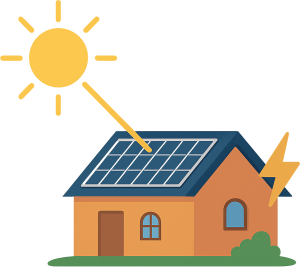
1. Solar panels capture sunlight and produce electrical energy.

2. An inverter transforms the DC electricity into AC power for household use.
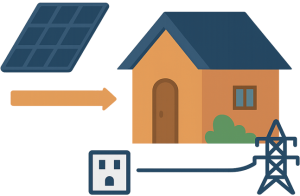
3. Your home draws from this solar power first, lowering dependence on the grid.
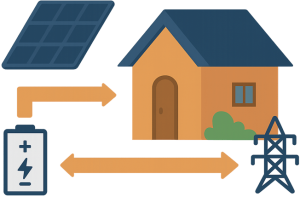
4. Any surplus energy is either fed back into the grid or stored in a battery if available.
Ontario Solar Panel Output: How Much Power Will You Generate?
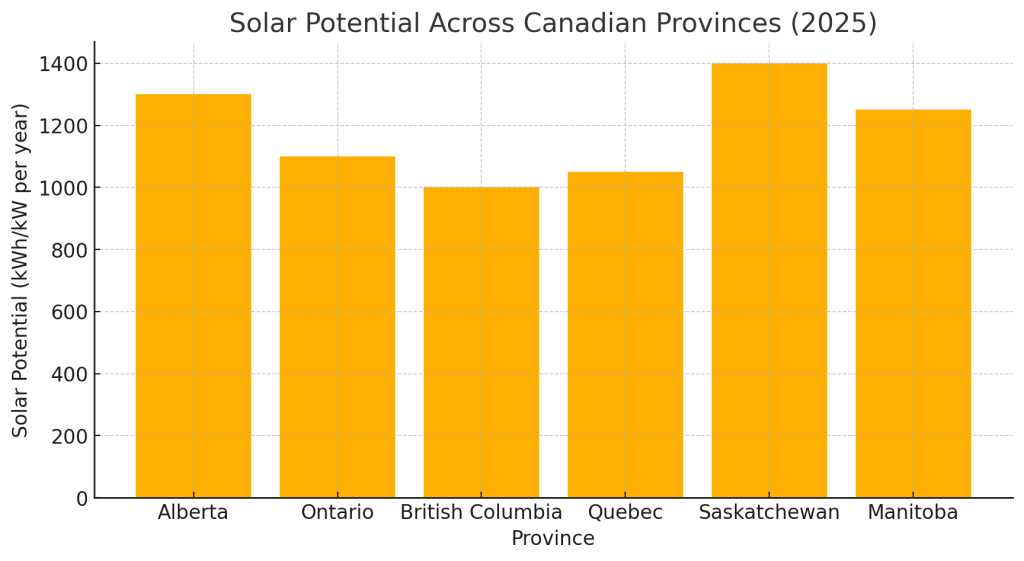
Ontario receives 1,800–2,200 hours of sunshine annually, giving solar systems a production potential of 1,000–1,200 kWh per kW installed per year. That’s enough for a well-sized 8–10 kW system to offset 80–100% of an average Ontario home’s electricity use. Cities like Ottawa and Toronto actually perform toward the top of this range, making Ontario a stronger solar market than many homeowners assume.
Ontario’s net metering program means you don’t need to produce the same amount every month — summer surplus credits offset winter shortfall, so annual production is what matters for your bill.
| Province | Average Annual Sunlight Hours | Solar Potential (kWh/kW per year) |
|---|---|---|
| Alberta | 2,300 - 2,600 | 1,200 - 1,400 |
| Ontario | 1,800 - 2,200 | 1,000 - 1,200 |
| British Columbia | 1,500 - 2,000 | 900 - 1,100 |
| Quebec | 1,700 - 2,100 | 1,000 - 1,150 |
| Saskatchewan | 2,400 - 2,700 | 1,300 - 1,500 |
| Manitoba | 2,100 - 2,500 | 1,150 - 1,300 |
Ontario's Electricity Rates & Why Solar Makes Financial Sense
Currently, Ontario produces roughly 55% of its electricity from nuclear power plants. Although this is a good solution with little to no emissions, nuclear energy isn’t renewable in the sense that solar, wind, and hydro are. It is in these areas that Ontario doesn’t produce as much electricity as Canada does on average.
In fact, Ontario produces roughly 24% of its power from hydro, while the Canadian average is 60%. Ontario scores better in wind energy, which produces roughly 8% of its electricity. Ontario also uses less petroleum and less biomass than Canada, but it offsets these carbon savings by using 8 times as much natural gas. Solar is more popular in Ontario than it is in the rest of the country, with roughly 5 times more solar than the rest of Canada averaged.
Fuel Type | Canada | Ontario |
Hydro | 60% | 24% |
Wind | 6% | 8% |
Petroleum | 0.3% | 0.1% |
Biomass | 1.4% | 0.8% |
Natural Gas | 1% | 8% |
Solar | 1% | 5% |
Other* | ~30.3% | ~55% |
Energy Profile: Canada and Ontario Comparison
* Other: Coal, Coke, and Nuclear (55%) combined
Source: CER
How Much Sunlight Does Ontario Get for Solar?
The amount of sunshine that falls on the specific surface, such as the province of Ontario, is never fixed, and it changes day to day and season to season. For this reason, you should not expect to be producing the same amount of electricity every single month.
In fact, the least sunny month in the province is December, when you can expect to produce roughly 52 kWh of energy for every kW of solar panels installed. The sunniest is July, 125 kWh, June, 124 kWh, and May, with 119 kWh of energy produced.
Month | kWh/kW of installed capacity in Ontario | Energy Production of a 5 kW system in kWh | Energy Production of a 10 kW system in kWh |
January | 66 | 330 | 660 |
February | 92 | 460 | 920 |
March | 109 | 545 | 1090 |
April | 115 | 575 | 1150 |
May | 119 | 595 | 1190 |
June | 124 | 620 | 1240 |
July | 125 | 625 | 1250 |
August | 118 | 590 | 1180 |
September | 104 | 520 | 1040 |
October | 86 | 430 | 860 |
November | 56 | 280 | 560 |
December | 52 | 260 | 520 |
Total – Annual | 1166 | 5,830 | 11,660 |
Energy Output per 1kW, 5kW and 10kW of installed solar capacity in Ontario
Source: Energy Hub
Needless to say, as energy production differs from one month to another and from one season to the next, different cities in Ontario will also yield different amounts of solar from the same solar system. The sunniest one is Ottawa, where you get almost 1,200 kWh per year for every kWh of solar capacity installed. The least sunny of all is Hamilton, where you produce 1,152 kWh in a system of the same size. Of course, no solar system is exactly 1 kWh in size, as most households decide to install anywhere between 5 and 10 kW of solar.
City | 1 kW System | 5 kW System | 10 kW System |
Toronto | 1,163 | 5,815 | 11,630 |
Ottawa | 1,199 | 5,995 | 11,990 |
Mississauga | 1,160 | 5,800 | 11,600 |
Brampton | 1,155 | 5,775 | 11,550 |
Hamilton | 1,152 | 5,760 | 11,520 |
Estimated Energy Production in different Ontario cities, with a 1kW, 5kW and 10kW solar system
Is Solar a Smart Investment in Ontario?
Ontario is one of Canada’s best provinces to go solar — not because of sunshine alone, but because of the combination of high peak electricity rates, a functioning net metering program, and the HRS rebate. A homeowner paying $200/month in electricity who installs an 8 kW system can realistically reduce that bill by 70–90%, with a payback period of 8–11 years and 15+ years of near-free power after that. At 8–12% annual return on investment, solar consistently outperforms GICs and savings accounts — with the added benefit of hedging against future electricity rate increases.
4. Ontario Solar Incentives & Rebates (2026)
Ontario’s solar incentive landscape changed significantly in 2024–2025. Both federal programs have closed, but the provincial HRS program is the real story in 2026 — and there’s a critical choice every Ontario homeowner needs to make before signing an installation contract.
1. Canada Greener Homes Grant — CLOSED Feb 2024
The Canada Greener Homes Grant closed permanently to new applications in February 2024. The Canada Greener Homes Loan closed on October 1, 2025. Neither program is accepting new applications. Existing approved applications continue to be processed.
Do not trust any installer who claims these programs are still available for new applicants.
2. Ontario Home Renovation Savings (HRS) Program ✅ Active
The Home Renovation Savings (HRS) Program — delivered through Save on Energy and Enbridge Gas, backed by the Ontario government — is the primary solar incentive in Ontario in 2026.
- Solar panels: Up to $5,000 ($1,000/kW, capped at 5 kW)
- Battery storage: Up to $5,000 ($300/kWh)
- Total maximum: $10,000 for solar + battery combined
- No home energy assessment required for the single-upgrade solar path
- Deadline: Program funded through late 2026 on a first-come, first-served basis
⚠️ Critical HRS trade-off: Homes that redeem the HRS solar rebate are generally not permitted to use net metering simultaneously. The rebate is designed for load-displacement systems — you generate and consume your own solar on-site rather than exporting to the grid. Before applying, confirm with your local distribution company (LDC) which path works best for your home’s energy profile.
Which path is right for you?
- Choose HRS + Battery: Best if you have high daytime usage, want backup power, or can time your consumption to solar production. The $10K rebate plus peak-shaving savings can deliver excellent ROI.
- Choose Net Metering: Best if you have a large system, high electricity bills driven by evening usage, or want the simplest setup. You earn full retail credit for every kWh you export.
3. Net Metering ✅ Active
Net metering allows Ontario homeowners to send excess solar power to the grid and receive a credit on their bill at your full retail electricity rate — including delivery and global adjustment charges. For most Ontario homeowners on Time-of-Use pricing, this is a powerful tool.
- Available through Hydro One, Toronto Hydro, Alectra, and most Ontario LDCs
- Credits accumulate and can offset future bills — unused credits expire annually
- No net cash payment: credits reduce your bill, they don’t generate income
- Not compatible with HRS solar rebate under current program rules
4. Local & Municipal Programs
Several Ontario municipalities and regions offer additional solar incentives that can be stacked on top of the HRS program:
- Durham Greener Homes Deep Retrofit Rebate: Up to $10,000 for qualifying deep energy retrofits (must achieve ≥50% GHG reduction). Check current availability with Durham Region.
- Toronto HELP Program: Home Energy Loan Program — up to $125,000 at low rates via Local Improvement Charge, repaid through property taxes. Note: HELP is not compatible with net metering.
- Guelph PACE Program: Property-assessed financing for energy upgrades including solar.
- Ottawa: Check with Ottawa Community Housing and Hydro Ottawa for current programs.
Municipal programs change frequently. Always verify current availability with your municipality before planning your installation.
💡 Pro Tip: The Ontario Home Renovation Savings (HRS) Program is funded on a first-come, first-served basis and is expected to run through late 2026. If you’re considering solar, apply before the program closes — up to $10,000 in rebates is a significant upfront reduction. Contact a pre-vetted installer to start your HRS application today.
Get Started Today
See the cost and savings you would have if installing solar on your house:
5. How Much Does Solar Cost in Ontario?
How Much Does It Cost to Install Solar Panels in Ontario?
Ontario solar costs have come down significantly but remain a meaningful investment. Prices vary by system size, panel type, installer, and whether you’re adding battery storage. Here’s what to expect in 2026 — with realistic after-incentive numbers based on what’s actually available today.
Solar Installation Costs in Ontario
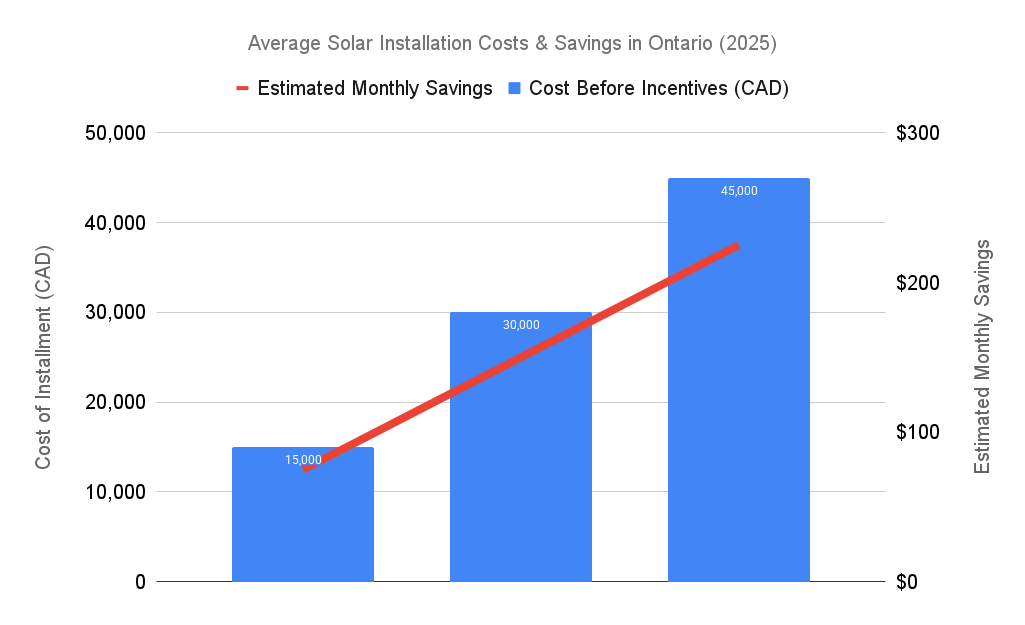
Here is a simple breakdown with estimated monthly savings for different system sizes. Here you can compare the cost of going for a 5, 10, or 15 kW system together with the return on investment periods:
| System Size | Cost Before Incentives | After HRS Rebate ($5K solar) | After Net Metering (no rebate) | Est. Monthly Savings | Payback Period |
|---|---|---|---|---|---|
| 5 kW | $14,000–$18,000 | $9,000–$13,000 | $14,000–$18,000 | $80–$130 | 9–14 years |
| 8 kW | $22,000–$28,000 | $17,000–$23,000 | $22,000–$28,000 | $130–$200 | 8–12 years |
| 10 kW | $26,000–$34,000 | $21,000–$29,000 | $26,000–$34,000 | $160–$250 | 7–11 years |
| 10 kW + battery | $38,000–$50,000 | $28,000–$40,000 | N/A (battery + net metering less common) | $200–$320 | 8–12 years |
Monthly savings estimated at Ontario’s blended residential rate (~14–16¢/kWh average). Peak-hour offset and TOU pricing can increase savings significantly. Incentives are subject to program availability.
* Larger systems cost more to install, but also generate more power. Contact experts to find out the perfect system size for your household.
What Factors Affect Solar Panel Costs in Ontario?
Several factors influence the total price of installing solar in Ontario:
1. System Size and Energy Requirements
The higher your energy needs are, the more solar panels you will need to install. This is the biggest determiner in any solar system. For this reason, what many households do is invest money into their home’s energy efficiency first and into reducing their energy needs as much as possible. This will mean that you will need a smaller solar system so that you will be saving both month after month on energy bills, as well as on the one-time solar payment.
2. Solar Panel Type and Quality
The next important factor to consider is the type of panels that you want to install. In general, households install either monocrystalline or polycrystalline panels. They come at different prices and energy efficiencies, but last roughly the same time, which is 25 years.
3. Battery Storage (Optional, but Recommended for Some Homes)
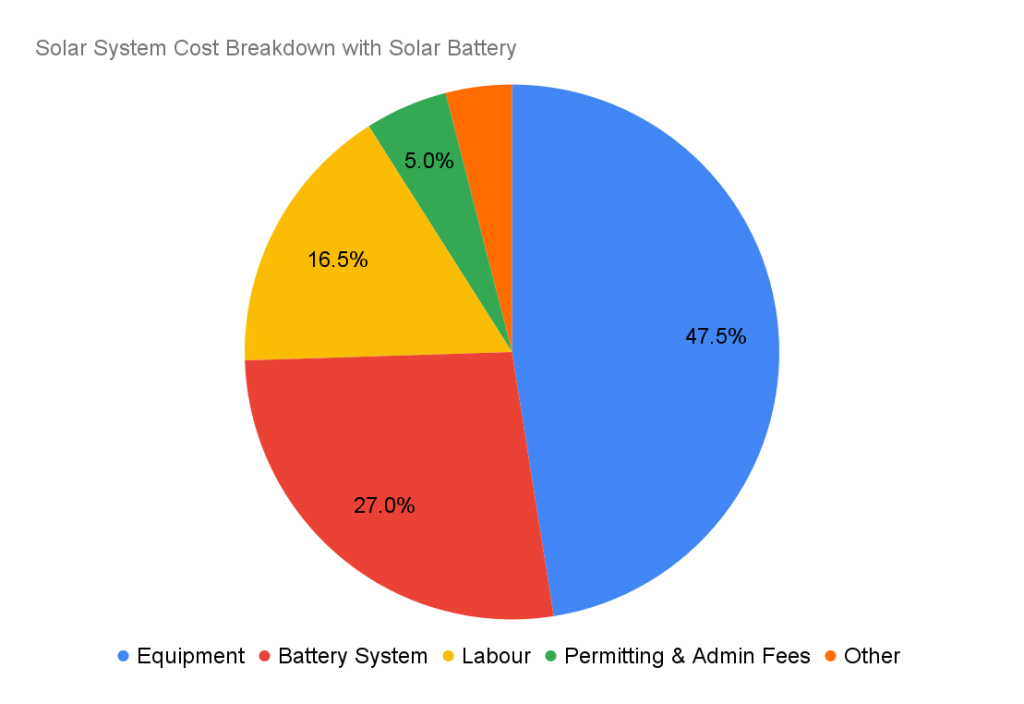
Most households decide not to install a solar battery. Solar batteries can be expensive, costing thousands for a single 5-10 kWh solution. As this is a significant amount of money for almost any household, it is important to understand that the same job that your solar battery does can be done virtually – under the net metering program. So, instead of spending almost $10,000 on a solar battery, you can spend anywhere between $0 and $1,700 for a bidirectional meter and an interconnection study.
4. Installation and Labour Costs
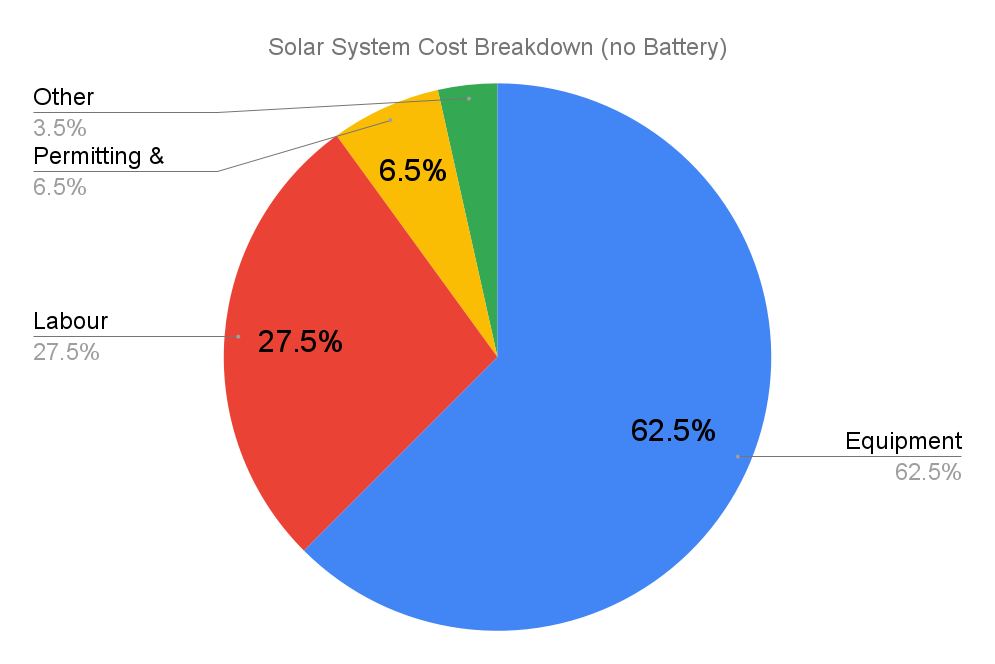
Installation and labor costs represent anywhere between 16 and 27.5% of your total solar costs. We suggest that you do not try to save money here, but rather to focus on online reviews and certification. Going for more economical installers now may result in damage to your solar panels or other vital components of your solar power system, so saving $1,000 today but paying five thousand long term doesn’t make much sense.
5. Incentives and Rebates in the Province
Ontario used to have very good provincial incentives and rebates for growing solar. However, besides the Ontario Home Renovation Savings Program, most of these programs are currently not available. Instead, you can focus on programs that are supposed to increase your household energy efficiency. This way, you can kill two birds with one stone, reduce your energy use, and reduce the size of the solar system that you need.
What Drives Up Solar Prices in Ontario?
Of course there are more factors that you should consider when buying solar. If you have an old roof, you may need to replace the whole roof or a portion of it, so it will be able to support the weight of solar panels. On top of this, if you’d like to install your solar system elsewhere on your property, you will need to pay for the mounting system itself.
Solar Panel Payback Period & ROI in Ontario
Ontario’s time-of-use electricity pricing makes solar particularly powerful. With peak rates at 39.1¢/kWh from 4–9 PM, a solar system that keeps you off the grid during evening hours delivers outsized savings. A well-sized 8–10 kW system typically saves Ontario homeowners $160–$250 per month, generating returns of 8–12% annually — significantly better than most savings accounts or conservative investments.
For homeowners adding battery storage and taking the HRS rebate path, the math improves further: store your cheap overnight power (3.9¢/kWh on the ULO rate), discharge during expensive peak hours (39.1¢/kWh), and earn the $10,000 HRS rebate on top. Some Ontario homeowners are achieving payback periods under 8 years with this combination.
6. How to Finance Solar in Ontario
Several financing options are available to Ontario homeowners who want to spread the cost of solar. Note that some financing programs are incompatible with certain incentive paths — confirm before you commit.
1. Solar Loans & Financing Plans
- Toronto HELP (Home Energy Loan Program): Up to $125,000 via Local Improvement Charge, repaid through property taxes. Low fixed interest. Note: not compatible with net metering.
- Green municipal loans: Several Ontario municipalities offer PACE-style financing for solar. Check with your municipality.
- Bank green loans: TD, Scotiabank, and RBC offer dedicated energy-efficiency financing. Rates vary — shop around.
2. Leasing Options and Power Purchase Agreements (PPA)
- Solar lease: Rent the system via fixed monthly payments; ownership remains with the provider
- PPA: Pay only for electricity produced at a set rate, typically lower than utility rates
3. Using a Home Equity Line of Credit (HELOC) for Solar
- Lower Interest Rates: HELOCs typically have much lower rates compared to personal loans or credit cards because they’re secured by your home.
- Flexible Borrowing: You can borrow as needed and pay interest only on the amount you use.
- Ownership Advantage: Unlike leasing or PPAs, you own the solar system outright, which means:
- You keep all savings from reduced electricity bills.
- You benefit from any available rebates or incentives.
- You increase home value by installing a permanent asset.
Ontario Solar Financing Options Compared
Financing Option | Benefit | Considerations |
Home Renovation Savings Rebate | Up to 30% off (≤ $5K solar, $5K battery) | No net metering allowed—must offset own usage |
Canada Greener Homes Loan | 0% interest, up to $40K | Requires EnerGuide evaluations |
HELP (Toronto) PACE Loan | Large amounts, low rate, property-tax repayment | Only available in participating cities |
Other PACE Programs | Flexible property-linked financing | Subject to municipal availability and terms |
Bank Loans / HELOC | Full ownership, flexible options | Interest applies; approval depends on credit |
Lease / PPA | No upfront cost, maintenance often included | No ownership, limited eligibility for rebates/credits |
Business Tax Credits (ITC, CCA, CRCE) | High incentives for commercial scale projects | Complex to apply—requires tax and accounting advice |
7. Choosing Solar Panels & Equipment
Most homeowners are worried that solar panels may look ugly on their roof or that they simply do not have a roof large enough to accommodate an entire solar system array. This is simply not true, as the average household needs fewer solar panels than you may think.
Solar panels average between 330 watts and 580 watts of power output. So, you will need anywhere between 20 and 34 solar panels for an average 10 kWh system. You should also consider that this system is a little bit oversized which is generally our recommendation.
Oversizing your solar energy system by roughly 10% can grant you roughly five more years of service life for your solar system. In some cases you may need to install more solar panels, but this is only if you do not have a south-facing roof slope that receives enough sunshine during the day to offset 100% of your energy use.
1. Tips for Selecting the Right Solar Panels
When it comes to choosing the right solar panels, you should understand that there are two basic types which are commonly used on Canadian homes, the monocrystalline and polycrystalline solar panels.
Monocrystalline Panels (Top Choice for Efficiency in Cold Climates)
Monocrystalline solar panels are more efficient, but they also come at a higher price tag. Their efficiency generally goes anywhere between 18 – 22%. The higher price tag is justified because they have a higher power output than their polycrystalline counterparts.
Polycrystalline Panels (Affordable and Practical Option)
Polycrystalline solar panels have slightly lower efficiencies when compared to monocrystalline panels. They can reach anywhere between 16 – 18% efficiency and although they produce less power, solar homeowners usually choose to go with more of these panels as they are simply more affordable.
Comparing Different Solar Panels
Monocrystalline panels are perfect when you have tight roof space and would like to get as much energy out of it as possible. On the other hand, polycrystalline panels are a much better solution when you have ample roof space or for larger solar installations.
Panel Type | Efficiency | Cold Weather Performance | Lifespan | Watts per Square foot | Cost |
Monocrystalline | 18-22% | Excellent | 25+ years | 20 – 28 | Higher |
Polycrystalline | 16-18% | Decent to Good | 25+ years | 14 – 19 | Lower |
Pro Tip: If your focus is on saving roof space, go for monocrystalline solar panels. But if you want to find a good balance between energy produced and the overall cost, polycrystalline panels may be the right solution for you.
2. How to Choose the Best Solar Inverter
Another important component of any solar system is the solar inverter. Solar inverters are special devices that convert the DC produced by solar panels into AC that your household appliances can actually use. There are three basic types of solar inverters: the string inverters, the microinverters, and the hybrid inverters.
1. String Inverters (Most Common and Cost-Effective)
String inverters are separate units that can handle the power output of your entire solar system at once. This comes with a slightly reduced efficiency as DC has to travel through more wiring to get to the actual inverter. However, due to their low price, they are very cost effective and are the most common type of solar inverter used in Canadian households.
2. Microinverters (Ideal for Shaded or Complex Roofs)
Microinverters, on the other hand, are installed on each solar panel individually. Most solar panels today actually come with microinverters, and because there is less wiring that the DC has to travel before it’s converted to AC, they feature lower power losses. Microinverters are perfect for roofs that are partially shaded throughout the day or if there is a high building nearby or any other source of shadow.
3. Hybrid Inverters (Perfect for Battery Integration)
When it comes to hybrid inverters, they act as string inverters in the sense that they are a completely separate unit that is usually mounted either in your attic or in your garage. However, hybrid inverters act as inverters and solar chargers at the same time, so they’re perfect for systems that have a solar battery included. This can slightly reduce the cost of purchasing a separate inverter and a separate solar charger in systems like these.
Side-by-Side Comparison of Solar Inverters
If you have a roof in full sunlight throughout the day, you can go for a string inverter and get good energy yields. However, in systems like these, even partial shading can significantly reduce the power output of your entire system. In these cases, microinverters are the best. However, if you’re looking to go off-grid or already have, hybrid inverters are the way to go. They will be able to convert all the electricity that you need to use in your household, as well as send excess to solar batteries.
Inverter breakdown by type:
Inverter Type | Best For | Efficiency | Expandability | Battery Storage | Cost |
String Inverter | Roofs with no shade | Good | Limited expandability, additional inverters are suggested with array expansion | No | Lower |
Microinverter | Roofs with partial shading, or multi-slope roofs | High | Yes | No | Higher |
Hybrid Inverter | Full sun with systems designed for future expansion | High | Yes | Yes | Higher |
Pro Tip: Go for microinverters if you have trees close to your home. Go for a string inverter if you have no trees and no battery. Opt for a hybrid inverter if you have a solar battery or plan on expanding your solar system with one.
Solar Battery Options and Considerations
Going for a solar battery is a must only if you plan to install your solar array in off-grid systems. A solar battery stores all the excess energy that you do not use right away and is able to balance higher energy use during certain parts of the day. However, solar batteries can cost thousands of dollars and can significantly increase both the upfront cost of your solar array and per kWh generation price.
Which Solar Setup Is Right for Your Ontario Home?
When it comes to choosing the right solar panels and solar inverter, you should pay attention to your roof, its orientation, and the slopes, as well as your energy needs and future solar plans. If you live in a well-lit area with very little shade on your rooftop, you will not make a mistake by going with polycrystalline solar panels and a string inverter.
8. Finding a Trusted Solar Installer in Ontario
Once you have a rough idea of what you want your solar system to be like, it’s time to start looking for a reliable solar installer in Ontario. This is easier said than done, so here are some factors that you should consider.
Why Hiring the Right Installer Is Crucial
Understanding Permits and Local Regulations
Solar installers in Ontario must follow all the provincial electrical codes. This is both for your own safety and for reducing fire hazard. They should also know all about municipal permits and net metering rules. The last thing you need is to finish installing your solar panel system only to realize that the utility company doesn’t want to connect it because some electrical code wasn’t followed through.
Getting the Most Out of Incentives and Rebates
Another thing that the solar installers should be able to do is to familiarize you with the available incentives and rebates. They should also be able to apply for those in your name.
Ensuring Long-Term Reliability and Warranty Coverage
Good solar installers will provide you with all the warranties that you need. In general, solar inverters come with warranties that are no longer than 10 years while your solar panels come with warranties that are at least 25 years long.
How to Avoid Scams and Poor-Quality Installations
Low price very often means low quality when it comes to solar installations. As solar panels are a very sensitive type of equipment, we always recommend not trying to save too much money on a solar installer. Paying the highest quote that you find also doesn’t make much sense because there is only so much quality that can be provided during the installation and mounting.
Essential Qualities of a Reliable Solar Installer
Now that you know what a good solar installation service looks like, let’s see how to find a solar installer in Ontario that can deliver this.
1. Verifying Installer Certification and Experience
First of all, you should look for installers that are certified. The responsible certification body in Canada is CSA or even the Canadian Solar Industries Association (CanSIA).
2. Do They Have Strong Customer Reviews?
They should have at least three years of prior experience. They should also feature strong customer reviews on Google local services and SolarGuide.ca.
3. Do They Offer Transparent Pricing and Warranties?
They should always offer transparent pricing and itemized quotes as well as the details on warranties and how long they last.
4. Do They Specialize in Ontario’s Solar Programs?
They should specialize in Ontario and federal solar programs and should be able to save you the most amount of money.
Searching for a Trusted Solar Installer?
At SolarGuide, we take the guesswork out of finding a reputable solar installer in Ontario. Here’s how it works:

We Rigorously Screen Every Installer
Only reputable, highly rated companies make our approved list.

Quality Comes First
We select installers based on proven performance — supported by verified reviews, transparent pricing, solid warranties, and industry expertise.
Easy Quote Comparison
Receive multiple competitive quotes, making it simple to choose the best system at the best price.

No Pressure, No Obligation
You’re in control — review your options and decide. If nothing fits, there’s zero obligation to proceed.
Get a Quote from a Pre-Vetted Solar Installer in Ontario
Want to find a trusted installer in Ontario? We’ve done the research for you. Get a free, no-obligation quote from a top-ranked, pre-vetted solar installer in your local area today!
9. Top Solar Companies Serving Ontario
Company | Customer Rating | # of Reviews | Get a Quote |
Energy Pal | 4.9 | 1.5K | |
XOLAR INC | 4.6 | 640 | |
Polaron Solar Energy | 4.5 | 353 |
10. The Solar Installation Process in Ontario
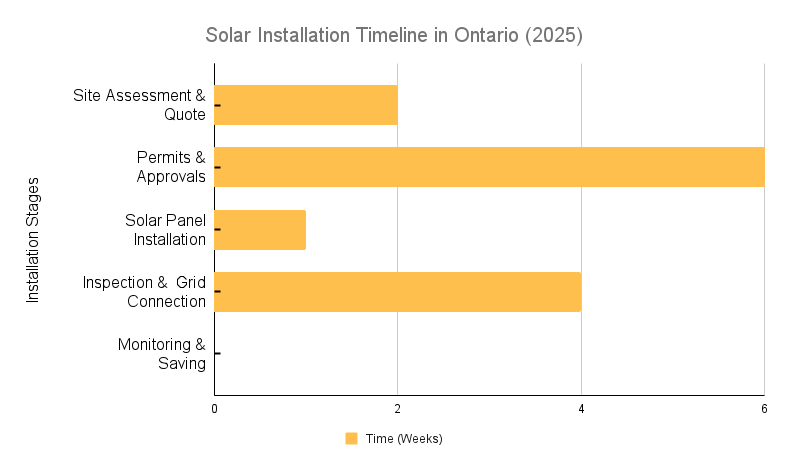
Mounting solar panels on your rooftop is a straightforward process, but there are important steps that you should consider. These steps are related to the actual assessment of your rooftop, getting the permits and approvals that are necessary, the installation of the solar panels, the inspection, grid connection or interconnection, and monitoring your solar savings.
Step 1: Site Evaluation & Getting Your Solar Quote (1–2 Weeks)
When it comes to the site assessment and the solar quote, this is a necessary step and a very crucial step that also includes an energy audit. So, a professional solar installer will visit your home to take a look at your rooftop. You should prepare several energy bills so that your total annual energy consumption can be seen.
Pro Tip: You should always get multiple quotes from experienced installers and then compare them before choosing the installer to go with.
Step 2: Securing Permits and Approvals (2–6 Weeks)
A good solar installer will be able to get the permits and approvals that are necessary. This is a long process that lasts anywhere between two and six weeks. These permits and approvals include municipal building permits, electrical permits, approval from your utility company, and interconnection study if necessary. During this period, you should also pay all the interconnection fees and interconnection study fees, which can go anywhere between $0 and $1,700, depending on your utility company.
Pro Tip: Some installers offer faster processing times because they have a lot of experience in handling all the necessary paperwork.
Step 3: Installing Your Solar Panels (1–3 Days)
Installation itself takes anywhere between one and three days, but most household systems can be installed in a single day. The installation team mounts solar panels on your rooftop. They install inverters and all the wiring that is necessary. If you want the battery storage as well, a solar charger and a solar battery are installed too.
Pro Tip: How long it will take to install your solar panels depends mostly on your roof slope and its condition.
Step 4: Final Inspection and Grid Connection (1–4 Weeks)
The inspection and grid connection take anywhere between one and four weeks. During this time, a final electrical inspection takes place and ensures the safety of the system being attached to the grid. Your utility company approves and activates bidirectional meters and net metering, and if you are approved, your system is finally turned on.
Pro Tip: After installation, you can expect anywhere between 1 – 4 weeks for the final inspection and approval by the utility company.
Step 5: Start Monitoring and Enjoying Your Solar Savings
Your solar installer will oftentimes be able to provide you with an app where you can monitor energy production in real time.
How to Get Started
Ready to install solar? Get a quote from a pre-vetted, highly ranked solar installer in Ontario today.
11. Net Metering vs. HRS Rebate — Ontario's Key Decision
Net Metering Explained for Ontario Homeowners
This is the most important decision Ontario solar buyers face in 2026. The HRS rebate ($10,000) and net metering are generally mutually exclusive. Understanding which path saves you more money over the life of your system will define your ROI.
How Ontario’s Net Metering Program Works
Net Metering path: Your panels send excess electricity to the grid. You receive a credit at your full retail rate (including delivery charges) — currently around 12–16¢/kWh blended. Credits roll over month-to-month but expire annually. You forego the HRS rebate but gain the simplicity of selling all your excess power at retail price.
HRS Rebate path: You receive $5,000–$10,000 upfront in rebates, but your system is designed for load displacement — you generate and consume solar on-site, ideally with battery storage to capture daytime production for evening use. With Ontario’s Ultra-Low Overnight (ULO) rate at 3.9¢/kWh vs peak at 39.1¢/kWh, charging a battery overnight and discharging during peak hours adds significant value on top of the rebate.
| Net Metering | HRS Rebate + Battery | |
|---|---|---|
| Upfront rebate | None | Up to $10,000 |
| Export credits | Yes (retail rate ~14¢/kWh) | No (load displacement) |
| Best for | Large systems, high evening use | Homes with battery, high daytime use |
| Complexity | Simple | Higher (requires battery) |
| Best payback scenario | 10+ kW system, net metering credits offset large bills | 8–10 kW + battery, high peak usage |
Rules change — always confirm with your LDC and the HRS program before installation.
Pro Tip: You should think of net metering as banking all the excess energy that you produce for later use.
What Do Utilities Pay for Surplus Solar Power?
In most cases, utilities will give you credits instead of payback for the solar electricity that you deliver into the grid.
Pro Tip: Before installing solar, you should first understand the net metering rates and how they can help you save.
Pro Tip: Before installing solar, you should first understand the net metering rates and how they can help you save.
Who Benefits Most from Net Metering?
- Solar home owners that can generate more electricity than they can use during the summer.
- Those that look for maximizing their return on investment, and
- Anyone who wants energy prices that are significantly lower, especially in the long run.
Net metering makes solar energy very affordable and very cost-effective for most households. In fact, what most households in Canada do is that they take out a solar loan with a low interest rate and then they install solar panels. The savings that they see on their energy bill are the money that is then sent to the banks to pay off the solar loan. After a while, usually after some six to ten years, the solar loan has been paid off and households can enjoy some 15 years of free solar electricity.
Ontario’s Solar Net Metering Buyback Rates (2026)
Solar buyback in Ontario works a little bit different when compared to solar buyback in other Canadian provinces. Namely, Ontario has 3 time-of-use (TOU) electricity rates: peak, mid-peak, or off-peak rates, and you will be credited the amount of money that is equivalent to the energy prices you would have paid for using that particular period of day without having solar panels.
The rates are as follows:
- the peak electricity rate 20.3 cents per kWh,
- mid-peak is 15.7 cents per kWh,
- and off-peak rates are 9.8 cents per kWh (OEB rates effective November 1, 2025).
This means that during the sunniest part of the day, you’ll mostly be receiving anywhere between 15.7 and 20.3 cents per kWh. As this is a flexible pricing scheme, you will be able to save even more by offsetting a part of your energy consumption from peak and mid-peak to the off-peak periods of the day, which is usually during the night. That way, you will be able to earn most money during the peak and mid-peak, as you will be delivering most energy into the grid. On the other hand, you can pull energy from the grid during the off-peak periods of the day, and therefore pay less. You should be careful that any amount that is accrued to your account is nullified every 12 months.
Important Things to Keep in Mind
Seasonal Rate Adjustments
As Ontario has a flexible pricing scheme, you will be able to save by offsetting a part of your energy consumption from peak and mid-peak to the off-peak periods of the day, which is usually during the night. That way, you will be able to earn more money during the peak and mid-peak, as you will be delivering most energy into the grid. On the other hand, you can pull energy from the grid during the off-peak periods of the day, and therefore pay less. You should be careful that any amount that is accrued to your account is nullified every 12 months.
Administrative Charges
There are administrative fees that you should consider before going solar in Ontario. You should be prepared to pay anywhere between $0 and $1,700 for the interconnection study and the actual bidirectional meter. In some other provinces you do not have to pay anything, but Ontario is a little bit different in this regard.
Program Flexibility
There is a lot of program flexibility in Ontario, although this flexibility isn’t observed through the seasonal rate adjustments. In fact, all the flexibility that you will be receiving is daily flexibility and switching between as many as three different rates during a single day.
12. Common Myths About Solar in Ontario
Ontario solar buyers encounter a lot of outdated information — especially about incentives that have closed and sunshine that’s supposedly insufficient. Here are the six most common myths debunked.
Myth #1: “Solar Panels Don’t Work in Ontario’s Cold Winters”
Myth #2: “Cloudy Days Make Solar Power Useless”
Fact: Solar panels generate power from diffuse light, not just direct sunlight. On overcast days, panels typically produce 10–25% of their peak output — enough to meaningfully offset your daytime consumption. Ontario’s net metering program handles the seasonal variability: summer surplus credits carry over to offset winter shortfall, so your annual production is what drives your savings, not any individual day.
Myth #3: “Solar Energy Is Too Expensive”
Fact: A 10 kW system costs $26,000–$34,000 before incentives — less than most home renovations. After the HRS rebate ($5,000–$10,000 for solar + battery) and with Ontario’s peak TOU rate at 39.1¢/kWh, most Ontario homeowners see payback in 7–12 years and 15+ years of near-free power after that. At 8–12% annual ROI, solar consistently outperforms GICs and savings accounts, with the added benefit of hedging against future Hydro rate increases.
Myth #4: “Solar Panels Damage Your Roof”
Fact: A properly installed solar system is waterproofed and flashed to code — it can actually extend roof life by protecting shingles from UV and weather. Problems only arise from poor installation, which is why choosing a certified, vetted installer matters. Look for installers with ESA (Electrical Safety Authority) certification and at least three years of Ontario experience. SolarGuide pre-vets all listed installers against these standards.
Myth #5: “Solar Panels Need Constant Maintenance”
Fact: Solar panels have no moving parts and require minimal maintenance. Ontario’s natural rainfall handles most cleaning. Snow slides off most roof-mounted panels or melts quickly. An annual visual inspection is recommended, and most Ontario installers include monitoring software so you can track output in real time. Manufacturers typically offer 25-year panel warranties and 10-year inverter warranties — your system should produce reliably for 25–30 years.
Myth #6: “Solar Won’t Increase Property Value”
Fact: Research consistently shows solar increases home resale value. In Ontario’s high-electricity-cost environment, buyers actively value homes with lower monthly operating costs. Homes with owned (not leased) solar systems typically sell faster and at a premium. If you take the net metering path, the system transfers with the home — credits and all. Note: if you’ve taken the HRS rebate, confirm program rules around property transfer with your LDC before selling.
Frequently Asked Questions: Solar Panels in Ontario
How much do solar panels cost in Ontario in 2026?
Solar panel systems in Ontario cost between $14,000 and $34,000 installed, depending on system size. A typical 8 kW system runs $22,000 to $28,000 before incentives. After the Ontario Home Renovation Savings (HRS) rebate of up to $5,000 for solar, net costs drop to $17,000 to $23,000. Adding battery storage increases total cost but unlocks an additional $5,000 HRS rebate, bringing the combined maximum rebate to $10,000.
What is the Ontario HRS rebate for solar panels?
The Ontario Home Renovation Savings (HRS) Program offers up to $5,000 for solar panels ($1,000 per kW, capped at 5 kW) and up to $5,000 for battery storage ($300 per kWh), for a combined maximum of $10,000. The program is delivered through Save On Energy and Enbridge Gas and is funded through late 2026 on a first-come, first-served basis. Importantly, homes claiming the HRS rebate generally cannot simultaneously enrol in net metering — confirm with your local distribution company before applying.
Can I use net metering and the HRS rebate together in Ontario?
Generally no. Ontario’s Home Renovation Savings (HRS) rebate and net metering are mutually exclusive under current program rules. The HRS rebate is designed for load-displacement systems — you generate and consume solar on-site. Net metering, available through Hydro One, Toronto Hydro, Alectra, and most Ontario LDCs, gives you full retail-rate credits for excess power sent to the grid but comes with no upfront rebate. You must choose one path before installation and confirm with your local distribution company (LDC).
Is solar worth it in Ontario?
Yes, solar is a strong investment in Ontario in 2026. With peak time-of-use electricity rates at 39.1 cents per kWh (4 to 9 PM), a well-sized solar system can offset your most expensive grid consumption. Most Ontario homeowners see payback periods of 7 to 12 years and annual returns of 8 to 12 percent on their investment — significantly better than savings accounts or GICs. The HRS rebate and HST exemption on solar equipment improve the economics further.
What solar rebates are available in Ontario in 2026?
The primary active solar rebate in Ontario is the Home Renovation Savings (HRS) Program — up to $10,000 for solar and battery combined ($12,000 with bundled upgrades), funded through late 2026. Net metering is available through most Ontario LDCs at the full retail rate. Toronto homeowners can access the HELP program for up to $125,000 in low-interest financing via property taxes. Ottawa offers the Better Homes Loan at $125,000 at 4.33 percent fixed. The Canada Greener Homes Grant closed in February 2024 and the Greener Homes Loan closed October 1, 2025.
How long does solar installation take in Ontario?
The full process from quote to energization typically takes 8 to 14 weeks in Ontario. This includes 1 to 2 weeks for site assessment and quotes, 2 to 6 weeks for permits and utility approvals from your local distribution company, 1 to 3 days for physical installation, and 1 to 4 weeks for final inspection and grid connection. Choosing an experienced installer who regularly works with Ontario LDCs can significantly reduce the permit and approval timeline.
Do solar panels work well in Ontario winters?
Yes. Solar panels actually operate more efficiently in cold temperatures than in heat. Ontario receives 1,800 to 2,200 sunshine hours annually — comparable to Germany, which is one of the world’s leading solar markets. Winter months produce less energy (around 52 to 92 kWh per kW installed in December and February), but Ontario’s net metering program allows summer surplus credits to offset winter shortfalls, making annual production the key metric for calculating your savings.
How do I find a trusted solar installer in Ontario?
Look for installers with ESA (Electrical Safety Authority) certification and at least 3 years of experience working specifically with Ontario LDCs and the HRS rebate program. Installers should provide itemized quotes, explain the HRS versus net metering trade-off for your specific situation, and handle permit and rebate paperwork on your behalf. SolarGuide.ca pre-vets every listed Ontario installer based on certification, reviews, and customer satisfaction — get free quotes from multiple vetted companies to compare.
13. The Future of Solar in Ontario
Future of Solar Energy in Ontario
Currently, Ontario has lower energy prices than the Canadian average. However, that still doesn’t mean that the energy prices are low. Going solar enables you to reduce how much you pay on electricity every month, and also enables you to gain more energy independence. By going solar, you will also be reducing your carbon footprint.
What’s Driving Solar Growth?
- Generous incentives and rebates on the federal level and on the provincial level help to significantly reduce the solar installation cost.
- Solar potential – although Canada is not as sunny as some other countries, it still offers plenty of sunshine for solar homeowners. Ontario features some 2,000 to 2,200 sunny hours every year.
- Canadians are also eco-conscious, so you can enjoy a reduced carbon footprint as well.
Solar Panels by City in Ontario
Ontario is home to Canada’s largest solar market. Explore solar installers in your city — we’ve pre-vetted every company so you get reliable quotes from experienced local installers.
| 📍 Toronto → | 📍 Ottawa → | 📍 Mississauga → | 📍 Brampton → |
| 📍 Hamilton → | 📍 London → | 📍 Markham → | 📍 Vaughan → |
| 📍 Kitchener → | 📍 Windsor → | 📍 Burlington → | 📍 Sudbury → |
| 📍 Oshawa → | 📍 Barrie → | 📍 Kingston → | 📍 Guelph → |
Can’t find your city? Use our free solar calculator for a personalized estimate anywhere in Ontario.
Exploring solar in another province?
📍 Alberta → 📍 British Columbia → 📍 Nova Scotia → 📍 New Brunswick → 📍 Saskatchewan → 📍 Manitoba →
15. Conclusion: Is Solar Worth It in Ontario?
Ontario features enough sunshine to enable you to offset 100% of your energy needs. This can be done even with a system as small as 8 to 9 kW. The return on investment period is relatively short and the quality of solar panels installed in Canada is high. Obtaining all the permits takes time, but this is an easy part and can also be done by the solar installer themselves. Most Canadian provinces, and Ontario especially, allow you to connect your power system to the net metering program. On top of this, you can enjoy additional benefits and an even shorter return on investment period by tuning your energy use around time of use tariffs.
Pro Tip: When looking for a solar installer, always compare multiple quotes to make sure you find the balance between quality and price.
Why 2026 Is the Right Time to Go Solar in Ontario
- You can reduce your energy bill by up to 90%. Most households that own solar only pay fixed energy bill costs.
- You can access generous rebates and incentives. They’re available both on the provincial level and on the federal level. In Ontario, the provincial level rebates and incentives are available only for home energy efficiency improvements.
- Increasing your property value.
- Increasing your home resale value
Get Started Today
See the cost and savings you would have if installing solar on your house: