The Ultimate Guide to Going Solar in New Brunswick (2026)
A Complete Guide to Solar Energy in New Brunswick
See Solar Prices Near You
Enter your postal code to see what solar panel installations cost in your local area.
1. Introduction: Why Go Solar in New Brunswick?
Investing in solar energy in New Brunswick isn’t just an eco-friendly choice, but it can also make strong financial sense. As the average New Brunswick household spends between $110 and $160 per month on electricity, you could be saving a lot of money. Depending on the size of the system, you could offset up to 100% of your electricity bill. The exact savings depend on your home’s energy efficiency and the size of your solar array system, but a good solar system will bring you very close to spending almost nothing on electricity.
At the same time, when installing a solar system, you’re also increasing your home’s value and resale value. This means that you can help preserve New Brunswick’s natural landscapes while at the same time gaining energy independence and increasing your home value.
Key Takeaways
- Average home solar system costs in New Brunswick: for an average 5kW system, $13,500 – $17,000
- Solar panels cost on average: $3.05 per Watt
- New Brunswick solar incentives and rebates: Canada Greener Homes Grant, New Brunswick Net Metering Program, and Total Home Energy Savings Program
- Average price per sq. foot for solar in New Brunswick: As the average home in NB is around 1,750 sq.feet and uses roughly 11,000 kWh of energy per year, a home like this would need ~10kW of solar installed, at a cost of $22,000 after rebates. That’s only $12.57 per sq. foot.
2. How Solar Energy Works
The Basics of Solar Energy
Solar power systems capture sunlight and convert it into electricity that you can use throughout your home. However, the electricity coming out of the solar panels is DC electricity, which you cannot use right away. A solar inverter is installed to help convert DC into AC, which your appliances can use. Usually, a solar battery is added to a solar system. This way, you have means of storing all the excess electricity that you do not use around your house.
As batteries increase the total cost of your solar system, it is usually recommended that you apply for net metering. Net metering is available in New Brunswick, and it is a good program that allows you to feed excess electricity into the grid. You can only do this when there is surplus in the production.
During the night or during the colder winter months, as you produce less solar electricity, you can draw electricity from the grid. With net metering in place, the electricity you will be drawing from the grid is the same electricity you’ve fed into the grid during the day or the summer months – so you do not pay for it. This way, the grid effectively acts as a ‘virtual solar battery’ of a kind, saving you money on installing an actual battery.
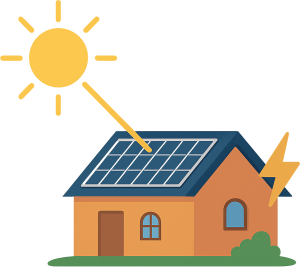
1. Sunlight hits the solar panels, producing solar power.

2. The inverter converts DC power into AC for home appliance use.
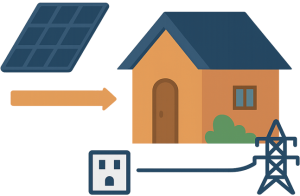
3. Your home uses the solar energy first, reducing reliance on the grid.
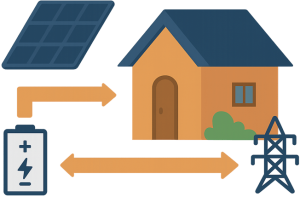
4. Excess electricity is sent to the grid, or the solar battery if you have one.
3. New Brunswick's Solar Energy Potential
A common concern among homeowners in New Brunswick is that there are not that many sunny hours to produce enough solar energy to make the solar system pay off. However, this is simply not true. New Brunswick features around 1,900 hours of direct sunlight every year, which is more than enough to meet the energy needs of an average New Brunswick household.
Currently, New Brunswick produces more power from natural gas than the rest of Canada. Roughly 14% of the energy you use in your household comes from natural gas. Although this is a transitional fuel, it is still not 100% clean, so going solar could also reduce your carbon footprint.
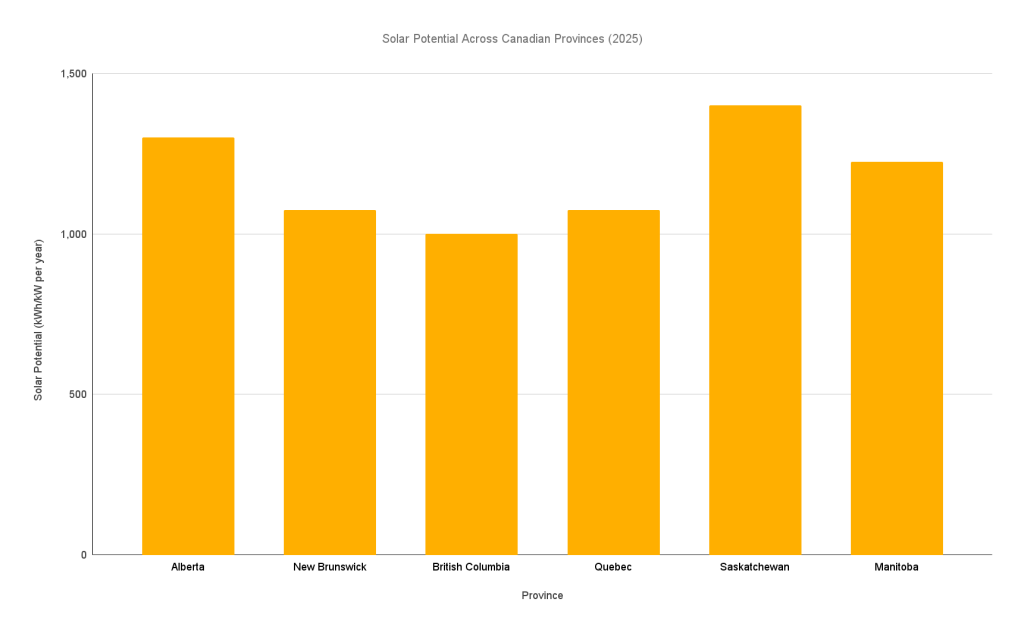
| Province | Average Annual Sunlight Hours | Solar Potential (kWh/kW per year) |
|---|---|---|
| Alberta | 2,300 - 2,600 | 1,200 - 1,400 |
| New Brunswick | 1,800 - 2,000 | 1,000 - 1,150 |
| British Columbia | 1,500 - 2,000 | 900 - 1,100 |
| Quebec | 1,700 - 2,100 | 1,000 - 1,150 |
| Saskatchewan | 2,400 - 2,700 | 1,300 - 1,500 |
| Manitoba | 2,100 - 2,500 | 1,150 - 1,300 |
On top of this, it is also important to note that there are many federal and provincial incentives and rebates that are available for those that decide to go solar. The net metering program allows you to make a smaller system that costs less and provides you with the same benefits of a larger system with a solar battery.
Rebate programs give you back some money and the rebate that you get is usually calculated per number of watts of installed power on your property. Needless to say, going solar also helps you gain energy independence and protects you from the ever-rising energy prices. The price of solar panels has dropped by more than 80% in the past decade and this is a trend that is likely to continue.
| Fuel Type | Canada | New Brunswick |
|---|---|---|
| Hydro | 60% | 23% |
| Wind | 6% | 6% |
| Petroleum | 0.3% | 0.4% |
| Biomass | 1.4% | 5% |
| Natural Gas | 1% | 14% |
| Solar | 1% | 0.1% |
| Other* | ~30.3% | ~51% |
Energy Profile: Canada and New Brunswick Comparison. * Other: Coal and Nuclear combined
As anyone living in Canada knows, the winters in Canada can be long and dark, so it is important to consider net metering as a viable option for your household. For comparison’s sake, November and December in New Brunswick are the least sunny months, with roughly 60 hours of sunlight or 2 hours of direct sunlight per day. As opposed to these, August offers 113 hours of direct sunlight. These numbers roughly translate to how many kWh of energy you can get per kWh of installed power. As the average household in New Brunswick uses roughly 11,000 kWh of electricity per year, a 10 kWh system would be a great option for most households.
| City | 1 kW System | 5 kW System | 10 kW System |
|---|---|---|---|
| Moncton | 1,144 | 5,720 | 11,440 |
| Saint John | 1,133 | 5,665 | 11,330 |
| Fredericton | 1,147 | 5,735 | 11,470 |
| Dieppe | 1,144 | 5,720 | 11,440 |
| Riverview | 1,141 | 5,705 | 11,410 |
Different cities in New Brunswick receive different amounts of sunlight. So the sunnier your city is, the more energy you will be drawing from your solar system. A single kilowatt of solar power installed in Saint John is going to yield 1133 kWh of solar power every year. However, that same kilowatt-hour installed in Fredericton is going to yield 1147 kWh. A slight difference, but an important one to consider.
| Month | 1 kW System | 5 kW System | 10 kW System |
|---|---|---|---|
| January | 78 | 390 | 780 |
| February | 96 | 480 | 960 |
| March | 113 | 565 | 1,130 |
| April | 105 | 525 | 1,050 |
| May | 109 | 545 | 1,090 |
| June | 111 | 555 | 1,110 |
| July | 112 | 560 | 1,120 |
| August | 113 | 565 | 1,130 |
| September | 103 | 515 | 1,030 |
| October | 83 | 415 | 830 |
| November | 60 | 300 | 600 |
| December | 60 | 300 | 600 |
| Total – Annual | 1,143 | 5,715 | 11,430 |
Does Solar Make Sense in New Brunswick?
Investing in solar in New Brunswick pays off. Long summer days are perfect to go net zero carbon while relying solely on your own electricity production for your domestic needs. This is also the perfect time to build up some credits with your NB Power and use them during the winter when you need them the most.
4. Solar Incentives & Rebates in New Brunswick
There are multiple incentives to help you reduce the initial cost of going solar in New Brunswick:
1. Canada Greener Homes Grant
- ❌ Closed: The Canada Greener Homes Grant stopped accepting new applications in February 2024 and is no longer available. It is listed here for historical reference only — do not apply.
2. New Brunswick's Net Metering Program
- Sell excess electricity back to the grid – earn credits that you canu se when the sun is down
- Reduce long-term electricity cost and avoid purchasing a solar battery
3. Total Home Energy Savings Program
- The Total Home Energy Savings Program offers $0.2 per Watt of installed power.
- The total rebate amount cannot be higher than $3,000.
- Systems up to 15 KW are eligible for this rebate.
- Registration for this rebate closed May 27, 2026; applicants who registered before that date have until January 31, 2027 to complete installation. No new registrations are being accepted.
Pro Tip: Check with your local municipality, utility company or solar installer for latest news on rebate availability.
Get Started Today
See the cost and savings you would have if installing solar on your house:
5. The Cost of Going Solar in New Brunswick
How Much Do Solar Panels Cost in New Brunswick?
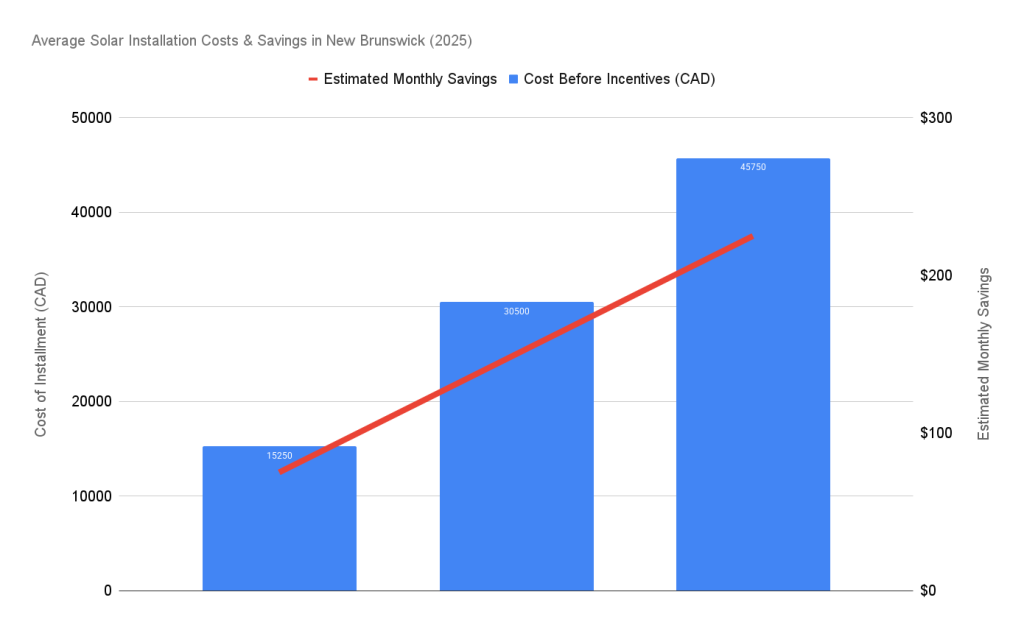
Solar system installation in New Brunswick is not as expensive as most people think it is. With the average price of $2.70-$3.40 per watt of installed power, New Brunswick is not more expensive than the majority of Canadian provinces. The final price of your solar system depends on many factors, including your solar system size, the type of solar panels you choose, the orientation and the slope of your roof, and many, many more. It is useful to consider that there are incentives and rebates that can help you bring this cost down by roughly a third.
The average payback time for a 10kW system is between 7 and 10 years. Most solar systems will last you for a minimum of 25 years before you would consider replacing the system. This doesn’t mean that your system will stop producing electricity within these 25 years, but rather that its total efficiency will drop to about 80% of the power you get at the beginning of the system’s life cycle.
Average Solar Installation Costs in New Brunswick
| System Size | Average Cost (Before Incentives) | Average Cost (After Incententives) | Estimated Monthly Savings | Payback Period |
|---|---|---|---|---|
| 5 kW | $13,500 - $17,000 | $5,500 - $9,000 | $50 - $100 | 8 - 12 years |
| 10 kW | $27,000 - $34,000 | $18,500 - $25,500 | $100 - $200 | 7 - 10 years |
| 15 kW | $40,500 - $51,000 | $32,500 - $43,000 | $150 - $300 | 7 - 10 years |
* Large systems cost more but produce more energy as well – make sure you check out the appropriate size for your home with a professional
What Affects Solar Panel Costs in New Brunswick?
As we’ve mentioned before, there are multiple factors that can affect the total price of your solar system. Some of those include the system size, your energy needs, solar panel type, solar panel quality, whether or not you choose to go with battery storage, the installation costs and labor, the incentives and rebates that are available in your region, as well as the state of your roof.
1. System Size & Energy Needs
Needless to say, the larger your solar system, the higher its costs will be.
The system size is one of the biggest contributors to your solar array cost.
The system size is determined by your energy use. To gain a better insight into how much energy your system will need to produce, you should sum up the total energy use for the past 12 months. You can find this information on your power bill. However, solar panel type and quality can also influence the price of your system.
2. Solar Panel Type & Quality
There are three basic types of solar panels: monocrystalline, polycrystalline, and thin-film solar panels. Monocrystalline are the highest quality solar panels that you can find on the market, but they also cost the most. This is a good option if you have a limited roof space or high energy needs, but they come at a premium.
3. Battery Storage (Optional but Recommended for Some Homes)
The price of solar batteries has dropped in recent years, but they are still a considerable item to put down on your solar system list. Currently, a battery system will add up around 27% to the total cost of your solar array. A 10 kWh battery is just the right size for most Canadian households. However, if you would like to store energy for multiple days, or if you would like to go off-grid, you may need several of these batteries.
4. Installation Costs & Labour
- The job is not complete without the installation itself and the labor that goes with it. When it comes to installing solar panels, these installation costs can add up to 16.5% to the total price.
- It’s important to understand that the installation costs can vary greatly depending on your location and how much work there actually is to be done.
- In some cases, a new roof with good orientation and slope can make the job very easy, but you should consider that the difficulty of accessing your site or the peculiarities to your own roof may prolong the works and increase the labor costs.
5. Available Incentives & Rebates
In general, you will see that incentives and rebates exist on both the federal and the provincial level. However, they should not be the sole determining factor in whether you will go solar or not. It is important to know that they can significantly reduce the total cost of your solar energy system. Sometimes, around $8,000 can be saved using incentives and rebates. However, the real charm of going solar is being able to produce your own electricity at a price that is only a fraction of the price of what you currently may be paying for.
6. What Factors Increase Solar Price in New Brunswick?
The difficulty of accessing your site, mounting solar panels to your roof, your roof orientation, and the slope are all the factors that can increase your solar price in New Brunswick. On top of this, you should add partial shading, possibly coming from nearby trees or other buildings, which would demand a larger system size and therefore an increase in the upfront cost as well. Another thing to consider is that some very old roofs or roofs that are in bad shape may need to be redone before your solar system is installed. As this is not a low-cost option, it is generally advisable to contact professionals and have them place a quote before any obligation is made.
Savings and ROI
Your New Brunswick power bill can be offset by up to 100% with the solar system of the right size. However, you should be careful that there are many wild allegations online. Namely, when it comes to the reduction of your power bill, it is important to note that it is only the variable part of the bill that is going to be reduced. When it comes to the fixed part that is paying fees for maintaining the connection to the grid itself, this part of the energy bill you will have to keep paying.
The only way to avoid that is to purchase a solar system of sufficient size and several solar batteries to go completely off grid. For most households, this is simply not an economic or a viable decision to make. So, most households will keep paying the fixed part of their energy bill despite having a solar system in place. However, the reduction in the variable part is going to be very noticeable, especially during the winter months and if you’ve managed to build up the excess energy credit during the summer.
6. Financing Options for Solar Panels in New Brunswick
1. Solar Loans and Financing Plans
Property Assessed Clean Energy is a financing option that offers solar financing options with $0 down, long amortisation periods and low interest rates. This loan is attached to your property and not your name. The installments are therefore paid for through your tax payments (LIC – Local Improvement Charge).
2. HELOC - Home Equity Line of Credit
HELOC (or HELC) is a home equity line of credit that is available in all Canadian provinces, including New Brunswick. You access this line of credit through your local bank – contact them and find out what their offer is – the programs are offered by government departments or electricity utilities and are realised through banks.
7. How Many Solar Panels Do You Need?
In general, the size of your solar system and how many solar panels you will have on your roof mostly depends on your energy needs and on the orientation and the slope of your roof. The closer you are to having a south-facing roof slope, the fewer solar panels you will need.
Two-slope roofs facing east to west may need more. You should always avoid placing your solar panels on the north-facing slope, as there is no direct sunlight coming there; there will be little to no power generation.
Most solar panels today come in energy efficiencies of between 16 – 22%, and they can produce anywhere between 330 and 580 watts of power output. When it comes to calculating how many solar panels you need, what you need to know is the total capacity of the solar system that you need and the type and the power output of the solar panels.
For example, if you need a 10 kilowatt solar system and you would like to purchase 400 watt solar panels, you will need 25 of them. However, if you opt for larger 500 watt solar panels, you will only need 20. In reality, this is much less than most homeowners in Canada think that they need, simply because people get used to seeing large solar farms without realizing how many homes a single solar farm like this can supply with clean electricity.
1. Choosing the Right Solar Panels
When it comes to different types of solar panels, it is important to know that there are polycrystalline and monocrystalline solar panels. On top of this, there is also the third kind, which are thin-foam solar panels, which are made in such a way that they remain flexible and their usage is limited to specific applications only.
Another kind that you may have heard of are the perovskite solar panels. However, they are still in the development phase and they’re not expected to hit the commercial shelves within the next few years.
Choosing the right solar panels and the accompanying equipment, such as the solar inverter, is a task that is best left to professionals, as there are a lot of calculations to take into consideration before making the final decision. Still, you can learn about different types of inverters and solar panels and be able to make an informed decision once the time is right
Monocrystalline Panels (Best for Efficiency & Cold Climates)
Monocrystalline solar panels are made of solar cells that are each made of a single piece of a silicon crystal.
When it comes to their efficiency, it doesn’t get much harder than this. Between 18-22% of the sunlight that falls onto this type of solar panel will get converted to electricity.
- They last for more than 25 years.
Polycrystalline Panels (Budget-Friendly Option)
- Unlike monocrystalline solar panels, which are black in color, polycrystalline solar panels come with bluish hues, so homeowners often prefer these.
- When it comes to their efficiency, it is a bit lower than that of monocrystalline solar panels, and they can convert anywhere between 16 – 18% of the sunlight that reaches them into electricity that you can use.
- They are very long-lasting, with a lifespan of 25 plus years. They cost a little bit less than monocrystalline solar panels, but you will also need to place more of them on your roof.
Solar Panels Comparison
Comparing monocrystalline and polycrystalline solar panels is relatively easy. Monocrystalline solar panels are more efficient than their counterparts, so you will need fewer of them. However, polycrystalline solar panels often look better on your roof, but you will need more of them, although they come at a lower price. It is for this reason that most homeowners actually base their decision on the number of solar panels that they need.
As monocrystalline are more efficient and you need fewer of them, they are a better solution for smaller homes and specific applications, such as supplying your RV with clean energy. However, if space is not a problem, or if you would like a ground-mounted system, polycrystalline solar panels win the race. As they cost less, they also come at a lower price even on large-scale projects.
| Panel Type | Efficiency | Cold Weather Performance | Lifespan | Watts per Sqft | Cost |
|---|---|---|---|---|---|
| Monocrystalline | 18 - 22% | Excellent | 25+ years | More | Higher |
| Polycrystalline | 16 - 18% | Decent to Good | 25+ years | Fewer | Lower |
Pro Tip: Monocrystalline panels are generally considered the best option. As New Brunswick is irradiated at lower angles, you may need more efficient solar panels to get the same amount of energy as someone living more southwards.
2. Choosing the Right Solar Inverter
You cannot connect your solar panels directly to your home electric power lines. What you need as a mediator between the two is a solar inverter. What the solar inverter does is that it converts the DC produced by your solar panels into AC that your household appliances can actually use. Of course, the story is not that simple. There are three basic kinds of solar inverters that you can choose from. They are the string inverters, microinverters, and hybrid inverters. Let’s check them out and compare them.
1. String Inverters (Most Common & Affordable)
- A single-string inverter can be used for an entire solar system.
- Lower cost, lower installation costs.
- Partial shading can reduce the efficiency of your solar power system.
2. Microinverters (Best for Roofs with Shade or Different Angles)
- Each microinverter is installed on a separate solar panel, so partial shading does not reduce the efficiency of the whole system.
- They come at a higher price.
- They offer higher conversion efficiency.
- More expensive than string inverter
3. Hybrid Inverters (For Battery Storage Integration)
- They can work with or without a solar battery.
- They allow for a later expansion of your solar system.
- They allow for a later expansion with a solar battery.
- General recommendation for all homeowners, although they come at a slightly higher price tag than string inverters.
Solar Inverters Comparison
In general, the string inverters are the most common option, but you should consider that this is an older technology that can be rigid to work with and barely allows any expansions further into the future.
If you consider expansions, then you should upsize your string inverter as well. Microinverters are the most efficient of all, as inversion of energy happens at the panels themselves. When it comes to hybrid inverters, they are currently the most recommended option, as they offer most flexibility with the sizing of your solar panel system and future expansions.
| Inverter Type | Best For | Cold Weather Performance | Efficiency | Battery Storage | Cost |
|---|---|---|---|---|---|
| String Inverter | Roofs without shade | Good | Limited expandability: additional inverters required | No | Lower |
| Microinverter | Roofs with partial shade or multiple slopes | High | Yes | No | Higher |
| Hybrid Inverter | Full sun | High | Yes | Yes | Higher |
Pro Tip: For roofs in full sun, a string inverter is often enough. However, if you have partial shading, microinverters are the best option there is.
3. Solar Battery Storage
Solar batteries can store anywhere between 5 and 10 kWh of energy for later use. They get recharged during the daytime when there is enough sunshine, and they get used up during night time or after the sun has already set. However, a single 10 kWh battery can increase your total solar installation cost by roughly a quarter. This is not something that many homeowners are happy with.
We recommend installing solar batteries if you plan to go completely off-grid or if you would like to enjoy your own energy generation even after the sun has set. Please do consider that most home batteries will not last you for several days. In fact, a single day of power supply is often the most that you can squeeze out of them. However, during winter months you may simply need more, especially if you plan to install a heat pump to keep your house warm during the cold winter months.
Final Thoughts
- Monocrystalline solar panels are the highest quality solar panels that you can find.
- Hybrid inverters are generally better than string inverters.
- Microinverters are possibly the best of them all.
8. Finding a Reliable Solar Installer in New Brunswick
Why Choosing the Right Solar Installer Matters
Proper Permits & Regulations
A good solar installer will be able to get all the municipal permits in your name. They should also be able to follow the provincial electrical code to the utmost, as there is a significant safety risk if the job isn’t done properly.
Maximizing Incentives & Rebates
They will be able to secure available rebates for you and assist you if you choose to apply for those.
Long-Term Reliability & Warranties
They should offer long-term warranties on both their labor and the equipment that they install. On a project of this size, you should never be accepting work done by anyone who cannot offer you warranties.
Avoiding Scams & Low-Quality Work
To avoid scams, you should always check out your installer online. Make sure to cover all the reviews and the grading that was given to them by their previous clients. If they offer a suspiciously low price, be certain that it will come at a suspiciously low quality.
What to Look for in a Solar Installer in New Brunswick
When you set on a journey to find the best solar installer in your area, here are some things to consider.
1. Are They Certified & Experienced?
They should be certified and should have at least three years of prior experience. They should be certified by the Canadian Solar Industries Association (CanSIA) or by CSA.
2. Do They Have Strong Customer Reviews?
You should check out their online reviews. Google and SolarGuides.ca can provide a neutral view when it comes to searching for your new solar installer. If you come across any overly positive or negative comments, you should read them but do not pay too much attention to them as you may want to consider moderate comments with pictures and actual testimonials first.
3. Do They Offer Transparent Pricing & Warranties?
They should also be able to offer transparent pricing and warranties for all the equipment that they install. When it comes to the transparent pricing, there should be no hidden fees, and the quote that is given to you should be how much you pay at the end of the project. Always be aware that certain issues may come up as the project unfolds, so a rotten roof beam that the roof inspection may have missed could be a potential cause of certain price increases.
4. Do They Specialize in New Brunswick's Solar Programs?
Installers should also specialize in New Brunswick solar programs, that is, they should be able to give you a plethora of information on solar rebates and incentives that are offered in your area.
Looking for a Reputable Installer?

We Pre-Screen Every Installer
Only the most reputable companies make our shortlist.

We Rank Based on Quality, not Quantity
We select installers based on proven performance—using independent reviews, verified rankings, transparent pricing, industry experience, and solid warranty coverage.
We Help You Compare Quotes
Receive multiple competitive quotes so you can choose the best system at the best possible price.

No Risk, No Obligation
Once you have your quotes, you decide. If none meet your needs, you’re under no obligation to proceed.
Get a Quote from a Pre-Vetted Solar Installer in New Brunswick
Want to find a trusted solar installer in New Brunswick? We’ve done the research for you. Get a free, no-obligation quote from a top-ranked, pre-vetted solar installer in your local area today!
9. Top 3 Solar Companies in New Brunswick
| Company | Customer Rating | # of Reviews | Contact |
|---|---|---|---|
| Sunly Energy | 4.8 / 5 | 208 | Get a Quote |
| Hayward Healthy Home Solutions | 4.7 / 5 | 571 | Get a Quote |
| XOLAR INC | 4.7 / 5 | 626 | Get a Quote |
10. The Solar Installation Process in New Brunswick
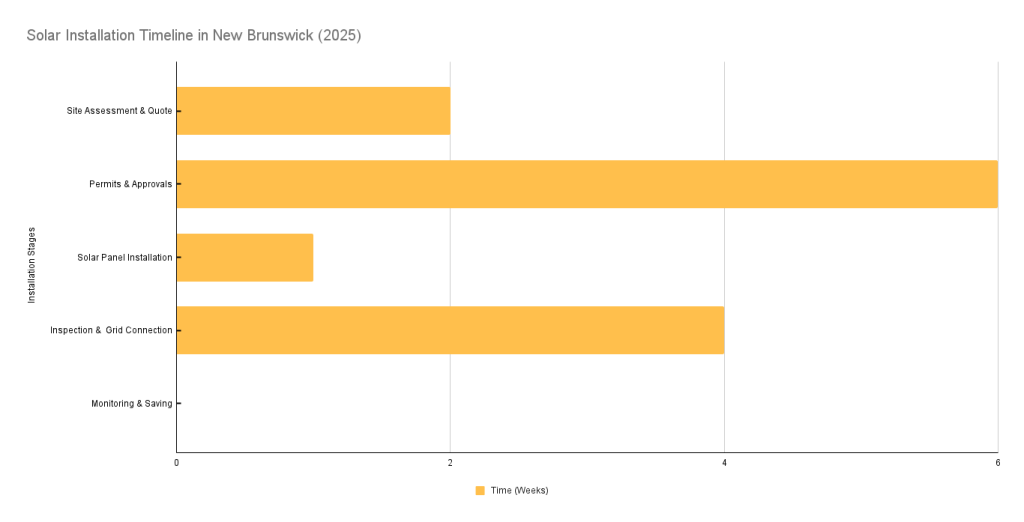
If you’re looking for a way to install a solar power system on your rooftop, there are several steps you should consider. Site assessment and getting an actual solar quote is the first step. Permits and approvals are the second, and they are followed by the actual solar installation and final inspection and grid connection. It may seem like much, but most of these steps are carried out by the solar installer. All you need is time and a little bit of patience.
Step 1: Site Assessment & Solar Quote (1-2 Weeks)
- A rooftop inspection is done by a professional on site.
- A simple energy audit is performed.
- You receive the detailed quotes with no hidden fees.
Pro Tip: Get multiple quotes – going with the first one you receive may result in unwanted outcomes or missed opportunities.
Step 2: Permits & Approvals (2-6 Weeks)
- Municipal building permits are obtained.
- Electrical permits are obtained as well.
- The approval from the utility company to establish interconnection is applied for.
Pro Tip: Experienced installers rely on their experience to reduce permitting time.
Step 3: Solar Panel Installation (1-3 Days)
- Mounting the solar panels.
- Wiring the entire system.
- Installing the solar inverter.
- Upgrading your solar inverter with a solar battery if you’ve decided to get one.
- System pre-testing.
Pro Tip: Most solar customers get their solar system installed in just 3 days or less.
Step 4: Inspection & Grid Connection (1-4 Weeks)
- The final system inspection is carried out.
- The utility company approves and activates your net metering services.
- The system is turned on.
Pro Tip: 1-4 weeks – the usual time necessary for inspection and final approvals.
Step 5: Monitoring & Enjoying Your Solar Savings
- Most solar systems come with a monitoring app so that you can track your solar energy generation.
- Regular maintenance is carried out.
- There is minimal maintenance.
11. Selling Excess Solar Power: Understanding Net Metering
Net metering is a program that has been introduced by different Canadian provinces to increase the number of solar installations done in the country. Under this program you sell access electricity to your utility company. However, you do not get paid in cash, but the kWhs that you deliver or feed into the grid are converted to energy credits that you can use once the sun is down.
During the daytime, when the sun is shining, you generate electricity, you use most of it, and then the excess is sent to the grid. This is the same energy that would otherwise be sent to a solar battery.
How Does Net Metering Work in New Brunswick?
- Your solar system generates solar energy.
- You use some of that energy.
- The extra power is fed into the grid.
- You earn credits for every kWh you send to the grid.
- You pull from these credits when your energy needs surpass your energy production.
Pro Tip: Think of net metering as ‘storing’ your solar power for later use.
How Much Do Utility Companies Pay for Excess Solar?
Although different utility providers may pay different amounts for the kWhs you deliver to them, it is necessary to note that NB Power currently pays the same amount as they charge for standard net metering – $0.1539 per kWh (updated April 2026; was $0.1338). Note: NB Power has proposed (Matter EL-003-2025, not yet approved) replacing this 1:1 rate with a buy-sell rate of 6.77¢/kWh purchase and 9.22¢/kWh sale plus a new demand charge – if approved, systems already enrolled or approved by October 31, 2026 would be grandfathered on today’s 1:1 rate until March 31, 2037.
Pro Tip: NB Power’s net metering rate is $0.1539/kWh as of its April 2026 rate increase (previously $0.1338). A proposed change (not yet approved) would replace this with a lower buy-sell rate starting 2027.
Pro Tip: If there are more than one utility company in your area, contact them and compare their feed-in tariffs.
Who Should Consider Net Metering?
Net metering is a program that is available to everybody, so if you plan on going solar, you should first consider net metering before looking into solar battery solutions. If you would like to go off-grid, however, net metering may not be the right thing for you because you will need to retain your connection in order to access the net metering program.
You should consider net metering if you:
- Want a lower ROI on your solar installment
- You want to decrease your carbon footprint even further
- You want to reduce the upfront costs of going solar by omitting a solar battery from your solar array system.
New Brunswick's Solar Net Metering Buyback Rates (2026)
Pro Tip: NB Power is New Brunswick’s sole electricity utility (Saint John Energy serves Saint John specifically), so unlike deregulated markets there’s no retailer comparison tool needed — contact NB Power directly or a local installer to confirm current net metering terms.
Key Considerations
Seasonal Rate Switching: There are no energy plans that allow you to switch your rates between different seasons. In fact, everybody pays the same electricity rates and they are applicable year-round. The only important thing to consider if you plan on going with net metering and a solar panel system is that the annual solar credits on your account expire every March.
Administrative Fees: When it comes to administrative fees, you should understand that your energy bill consists of two parts, the fixed part and the variable part. The variable part relates to how much energy you actually used and it changes month after month. However, the fixed part of your energy bill contains fixed fees, administrative fees, and any other regularly recurring costs connected to your account.
When you apply for net metering, the interconnection fee will have to be paid through this one. If you are with a St. John utility company, you will have to pay an administrative fee of $229.88 for standard net metering and $574.68 for virtual net metering.
12. Common Myths & Misconceptions About Solar
Solar is becoming progressively more popular in New Brunswick, however, a relatively slow adoption can be credited to some myths that persist. Let’s bust some of them:
Myth #1: “Solar Panels Don’t Work in Cold Climates Like New Brunswick”
Fact: Although New Brunswick is a bit on the colder side, this does not stop solar panels from working properly. In fact, as solar panels are more efficient at lower temperatures, you will be getting more kilowatt hours per every kilowatt hour installed compared to warmer places at the same latitude.
Myth #2: “Solar Power Doesn’t Work on Cloudy Days”
Fact: Solar works for as long as there is light, even if the light is dissipated, so if you experience a lot of overcast or cloudy days, you should be aware that your solar panels will keep producing energy. The total amount of energy produced will be lower than with direct exposure to sunlight, but there will still be plenty of energy for most households to get by.
Myth #3: “Solar is Too Expensive”
Fact: Solar is not too expensive. In fact, with roughly three dollars per watt of installed power, solar has become very cheap. In fact, in the past decade, the price of solar panels has dropped by more than 80%.
Myth #4: “Solar Panels Will Damage My Roof”
Fact: If properly installed, solar panels will not damage your roof. In fact, they barely have any interference with the roof. Solar panels are mounted on special mounts that are placed on your roof, and there is very little drilling that is done. If the installation is done by a professional solar panel installer, any spaces between the screws and your roof shingles will be made waterproof.
Myth #5: “Solar Panels Require a Lot of Maintenance”
Fact: Solar panels do not require almost any maintenance. A regular inspection once a year will do 90% of the work for you. However, if you live in a heavily wooded area and experience a lot of fallen leaves during the autumn and winter, you may want to occasionally remove the debris from your solar panels. Same goes if you live in a dustproof area, although in most cases rain will remove most of it for you.
Myth #6: “Solar Won’t Increase My Property Value”
Fact: Solar will increase your property value. In fact, properties with solar panels sell faster and for more money than properties without them. People love energy freedom and energy independence, and having solar panels means that you can tick two more boxes on your property description sheet.
Myth #7: “Solar is not Efficient”
Fact: Solar is very efficient. In fact, most solar panels on the market today are between 16 and 22% efficient. Although this may seem very low, you should consider that this is where the technology currently tops off. Although they’re not even close to 100% efficiency, you only need a few solar panels to see a big impact on your power bill.
Myth #8: “Solar Panels Can’t be Recycled”
Fact: Solar panels are made of glass, aluminum, and silicon, and as such are very easy to recycle. The thing is that this is a new technology, and even the first generation of solar panels that have been produced and made commercially available in Canada is still running and operating. This is the reason why there are not that many solar panel recycling plants in Canada.
13. Future of Solar Energy in New Brunswick
The generous net metering policies that are available in New Brunswick, federal government incentives, and high solar potential in the province make sure that an investment in a solar power system is a good investment. The solar market is likely to keep expanding, especially as Canada has set very ambitious renewable energy goals for its future. As the population of Canada keeps increasing, that will necessarily result in an increase in energy demands, and considering that Canada is a very eco-conscious country, that only translates in an increased need for solar power in the future.
Key Drivers:
- Lower costs – the price of solar panels has dropped by more than 80% in the past decade and it’s likely to keep decreasing.
- Generous government incentives – offer significant rebates for those who decides to go solar This can decrease your price by some average 20 to 35% of your upfront costs depending on your system size and the final price that you will be paying.
- Solar potential – although New Brunswick is not the sunniest place on the planet, it definitely has a lot of energy potential. A single 10 kilowatt system is enough to satisfy the needs of an average Canadian family and even surpass their total energy consumption.
14. Conclusion: Is Solar Right for You?
A decent solar system is likely to bring down your energy costs, to decrease your carbon footprint, and to help you reach energy independence. As energy prices have been increasing in the past years, the need for going solar is obvious. So if you believe that this is the right thing for you, you should request a quote and see what can be done to increase your property value decrease your energy costs, and help you reach your goals faster.
Pro Tip: Always ask for multiple quotes – there are many solar installers on the market, but not all of them are good – compare their offers.
Key Benefits of Going Solar:
- Reducing your energy bill by up to 90% and helping you reach energy independence.
- Using your utility company as a virtual battery to help you further bring down the upfront costs.
- Relying on generous rebates and incentives available throughout Canada.
- Reducing your carbon footprint.
- Increasing your property value and home resale value.
Get Started Today
See the cost and savings you would have if installing solar on your house: